
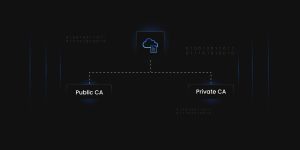
The two types of Certificate Authority are Public CAs, which are trusted by default in major browsers and issue certificates for public-facing systems, and Private CAs, which organizations run internally for certificates that never need to be trusted outside their own network.
Public CAs are third-party organizations, such as DigiCert or Sectigo, trusted by default in browsers and operating systems, making them the right choice for public websites and customer-facing applications. Private CAs are internal to an organization and issue certificates for internal systems, IoT devices, and code signing, offering more control but no automatic external trust.
Key Takeaways
- Public CAs are trusted by default in browsers; Private CAs are not. This single distinction drives almost every other difference between the two types.
- Public CAs offer DV, OV, and EV validation levels. Domain Validated, Organization Validated, and Extended Validation certificates trade issuance speed for progressively stronger identity verification.
- Private CAs give organizations full control over policy. Certificate types, validation procedures, and validity periods can all be customized without needing external CA approval.
- Private CAs are common for internal and IoT use cases. Internal communication, device authentication, and internally developed code signing rarely need public browser trust.
- Most enterprises run both simultaneously. Public CAs secure customer-facing systems while a Private CA secures internal infrastructure, each matched to what actually nee
What Is a Public CA?
A Public CA is a trusted third-party organization that issues certificates recognized automatically by major web browsers.
- Trusted third party. Public CAs are established, audited entities that both users and systems trust by default.
- Global reach. Certificates are trusted in most browsers out of the box, making them suitable for public-facing websites.
- Multiple validation levels. DV, OV, and EV certificates offer increasing levels of identity verification for different risk profiles.
- Browser compatibility. Popular browsers trust Public CA certificates automatically, avoiding security warnings for site visitors.
Public CAs are the right fit for e-commerce sites, online banking portals, and any public-facing application where visitors need automatic trust without installing anything.
What Is a Private CA?
A Private CA, also called an Internal CA, issues certificates for use within a closed or restricted environment.
- Internal use only. Private CA certificates are not trusted by external browsers by default, limiting them to internal applications.
- Customizable policy. Organizations set their own certificate types, validation procedures, and validity periods.
- Flexible certificate types. A Private CA can issue SSL/TLS, code signing, and email certificates for internal use.
- Full control over issuance. Every certificate issued follows policy the organization defines itself, rather than a public CA’s baseline requirements.
Private CAs fit internal network communication, IoT device authentication, and code signing for internally developed software, where public browser trust was never the goal.
Public CA vs Private CA
The right choice depends entirely on whether the certificate needs to be trusted outside the organization’s own systems.
| Attribute | Public CA | Private CA |
|---|---|---|
| Browser trust | Trusted by default | Not trusted externally |
| Typical use case | Public websites, customer portals | Internal systems, IoT, internal code signing |
| Validation levels | DV, OV, EV | Defined entirely by the organization |
| Governance | CA/Browser Forum Baseline Requirements | Organization’s own policy |
| Cost model | Per-certificate or subscription | Infrastructure and operational cost |
How can Encryption Consulting help?
PKI-as-a-Service from Encryption Consulting supports both Public and Private CA hierarchies, giving organizations a scalable way to run internal CAs for IoT and code signing while managing public certificate relationships from the same operational foundation. Backed by ISO/IEC 27001:2022 and SOC 2 certified practices.
Frequently Asked Questions
Can an organization use both a Public CA and a Private CA?
Yes, and most enterprises do. A Public CA secures customer-facing websites and applications that need automatic browser trust, while a Private CA handles internal systems, device authentication, and internal code signing where external trust was never required.
Is a Private CA less secure than a Public CA?
Not inherently. A Private CA can enforce stronger internal policy than a Public CA’s baseline requirements, since the organization controls validation and issuance directly. The tradeoff is that Private CA certificates carry no automatic trust outside the organization’s own systems.
What validation levels does a Public CA offer?
Domain Validated (DV) confirms only domain control and issues quickly. Organization Validated (OV) additionally verifies the legal existence of the organization. Extended Validation (EV) performs the most thorough identity checks, though modern browsers no longer display EV status differently in the address bar.
Why would an organization run its own Private CA instead of buying certificates?
A Private CA gives full control over certificate types, validity periods, and validation procedures without per-certificate cost from a Public CA. It fits use cases like IoT device authentication, internal service-to-service communication, and internal code signing, where public browser trust is not the goal.
Modernize Your CA Infrastructure
Explore PKI-as-a-Service to run Public and Private CA hierarchies from one scalable platform, or talk to an Encryption Consulting advisor about your CA strategy.