- Key Takeaways
- Who Should Care About This SafeNet KSP Error
- Prerequisites
- Understanding the SafeNet KSP Error
- Step-by-Step: Configuring the KSP Using the GUI
- Validating the Fix
- Common Errors and How to Fix Them
- Rollback Steps
- Quick Reference: Prerequisites, Validation, Errors, and Rollback
- How This Connects to Certificate Lifecycle Management
- This Error in Cloud, Hybrid, and Multi-CA PKI Environments
- Measuring Success and What to Audit Regularly
- Encryption Consulting's Take
- Conclusion
- Frequently Asked Questions
“SafeNet Key Storage Provider: Provider DLL failed to initialize correctly” (CertUtil error 0x80090030, NTE_DEVICE_NOT_READY) appears during Active Directory Certificate Services setup when the SafeNet Luna Cryptographic Key Provider option is missing from Server Manager. The fix is almost always a KSP registration or client-service issue, resolved by re-registering the HSM partition with KspConfig and rebooting the server.
This error surfaces in a specific way: KSPConfig is installed, the HSM setup itself completes successfully, but when the ADCS configuration wizard asks for a cryptographic provider, SafeNet Luna Cryptographic Key Provider simply is not in the list. Running certutil -csplist confirms the provider is present but not ready, which is a registration problem between the KSP and the HSM partition, not a missing installation.
This guide covers the full path: prerequisites, how to confirm the error signature, the step-by-step KSP registration process using KspConfig, validation checks after the fix, the errors administrators run into most often, and how to roll back safely if a registration attempt goes wrong.
Key Takeaways
- “Provider DLL failed to initialize correctly” with CertUtil error 0x80090030 (NTE_DEVICE_NOT_READY) means the SafeNet KSP is installed but not correctly registered with the HSM partition, not that the KSP software itself is missing or broken.
- The fix is to re-register the security library and HSM slots with KspConfig for both the Administrator user and the SYSTEM/NT-AUTHORITY account, then reboot the server before retrying ADCS configuration.
- Skipping the reboot after re-registering is the single most common reason this fix appears not to work; the registration only takes effect for CA services after a restart.
- Validate the fix with
certutil -csplistand confirm SafeNet Key Storage Provider appears as ready, then confirm it is selectable in the ADCS configuration wizard. - Enterprises relying on manual HSM and certificate configuration tracking reported certificate-related downtime in 45% of cases over the past year, with 37.5% of those outages caused specifically by an expired certificate, according to DigiCert’s Trust Pulse Survey, published July 2, 2025, the same operational blind spot applies to an unregistered or misconfigured KSP.
Who Should Care About This SafeNet KSP Error
This error blocks a CA build before the certificate authority itself is even configured. Here is what each team should actually do about it.
- PKI Administrators own the CA build sequence and the KSP registration steps. Action: confirm
certutil -csplistreports the SafeNet provider as ready before starting ADCS configuration, not after it fails. - Security Architects define the standard HSM client registration procedure for new CA builds. Action: document the KspConfig registration steps, including both the Administrator and SYSTEM account registrations, as a required pre-build step.
- Platform and Identity Teams run the HSM client installation and KSP registration in practice. Action: build a reboot checkpoint into the CA build runbook immediately after KSP registration, before attempting ADCS configuration.
- Compliance and GRC track whether HSM-backed CA builds follow a documented, repeatable configuration process. Action: add KSP registration verification to the PKI infrastructure build checklist.
- CISOs own the broader risk of PKI infrastructure builds stalling on undocumented HSM configuration steps. Action: treat KSP registration failures as a recurring risk to track, not a one-off troubleshooting note each time it happens.
Prerequisites
Confirm each of these before troubleshooting a KSP provider failure:
- A SafeNet Luna HSM with the client software and KSPConfig utility already installed on the target server
- Administrator privileges on the client to run KspConfig and complete Crypto Officer registration
- A completed HSM partition setup, with the partition already created and reachable from the client
- Access to the client install directory to locate
cryptoki.dllfor security library registration - A maintenance window, since resolving this requires a server reboot after KSP registration
Understanding the SafeNet KSP Error
The failure signature is consistent enough to match exactly before applying any fix. While configuring Active Directory Certificate Services on Server Manager, the option for SafeNet Luna Cryptographic Key Provider is not available, and CA Service is not working:

Running certutil -csplist against the provider returns:
- Provider Name: SafeNet Key Storage Provider
- Error: SafeNet Key Storage Provider: Provider DLL failed to initialize correctly.
- CertUtil: -csplist command FAILED: 0x80090030 (-2146893776 NTE_DEVICE_NOT_READY)
- CertUtil: The device that is required by this cryptographic provider is not ready for use.
Root Cause
The SafeNet Luna Cryptographic Key Provider option is missing from ADCS configuration even after installing KSPConfig and completing HSM setup, because the KSP itself has not been registered with the HSM partition for the accounts that need it: the Administrator user and the SYSTEM account under NT-AUTHORITY. Without that registration, Windows reports the device as not ready rather than reporting a missing registration, which is what makes this error look like a deeper HSM problem than it is.
Before concluding it is a registration issue, it is worth ruling out the more basic causes first:
- Run
certutil -csplistto confirm whether the SafeNet Key Storage Provider is listed and what state it reports. - Check that
vtl verifyreports the HSM partition and slots as available and working. - Try re-installing the KSP configuration if the provider does not appear at all.
- Check the Windows Registry to confirm the SafeNet provider entries are present under the cryptography provider keys.
If the provider is present but not ready, as it is in this error, the fix is registration, not reinstallation.
Step-by-Step: Configuring the KSP Using the GUI
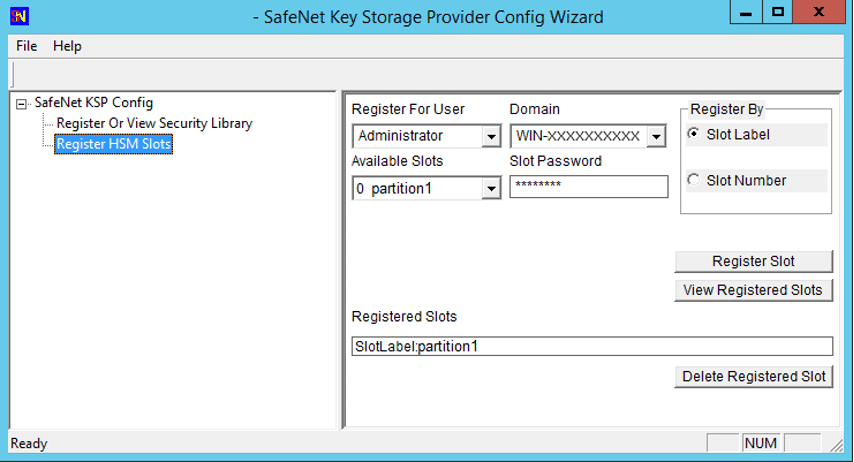
Use the KspConfig utility to register the KSP with your HSM partitions. The Crypto Officer must complete this procedure using Administrator privileges on the client. Two user/domain combinations need registering: the Administrator user with the client’s domain (default Windows domains follow the format WIN-XXXXXXXXXXX), and the SYSTEM user with the NT-AUTHORITY domain, since Windows services including certsvc run under the SYSTEM account. The configuration tool registers a Crypto Officer password or challenge to a specific user, so only that user can unlock the partition.
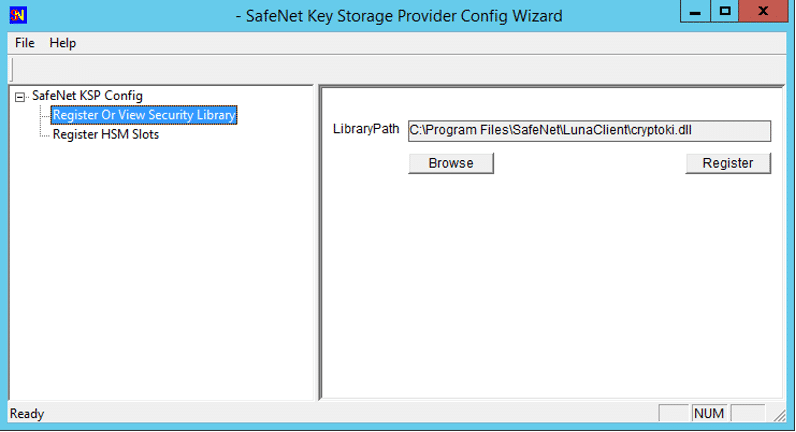
Register the Security Library
- In Windows Explorer, navigate to the Luna KSP install directory and launch KspConfig as the Administrator user.
- In the left panel, double-click Register or View Security Library. Enter the filepath to cryptoki.dll (typically
<client_install_dir>\cryptoki.dll) or click Browse to locate it. - Click Register to complete the registration.
Register HSM Slots for the Administrator User
- In the left panel, double-click Register HSM Slots.
- Select the Administrator user, client domain, and an available slot to register.
- Enter the CO password or challenge and click Register Slot.
Register HSM Slots for the SYSTEM Account
- Select the SYSTEM user and NT-AUTHORITY domain and register for the same slot.
- Repeat the slot registration for any other available slots you want the KSP to use.
- This step is the one most often skipped: ADCS runs certsvc under the SYSTEM account, so registering only the Administrator user leaves the CA service unable to reach the partition.
Reboot and Validate
- Reboot the server. Registration changes to the KSP do not take effect for CA services until after a restart, and reconfiguring without rebooting is the most common reason this fix appears not to work.
- After the reboot, run
certutil -csplistagain and confirm SafeNet Key Storage Provider now reports as ready. - Reopen the ADCS configuration wizard and confirm SafeNet Luna Cryptographic Key Provider now appears as a selectable option.
Thales’s own KSP and CNG documentation covers the full registration workflow and is worth keeping on hand for less common HSM configurations: Thales Luna KSP/CNG provider documentation.
Validating the Fix
Do not consider this resolved until all of the following check out, not just the first successful step:
- Run
certutil -csplistand confirm SafeNet Key Storage Provider reports as ready, with no NTE_DEVICE_NOT_READY error. - Run
vtl verifyand confirm the HSM partition and registered slots show as available. - Open the ADCS configuration wizard and confirm SafeNet Luna Cryptographic Key Provider now appears in the cryptographic provider list.
- Complete the CA configuration and confirm the CA service starts successfully using the registered provider.
- Confirm both the Administrator and SYSTEM account registrations are present in KspConfig, not just one of the two.
Common Errors and How to Fix Them
These are the issues administrators run into most often around this fix, beyond the original provider DLL error.
Provider Still Reports NTE_DEVICE_NOT_READY After Registration
If certutil -csplist still reports the device as not ready after registering both accounts, confirm the server was actually rebooted. A pending reboot, or a reboot that was cancelled, is the most common reason this error persists after an otherwise correct registration.
SafeNet Provider Still Missing from the ADCS Wizard
If the provider still does not appear in the ADCS configuration wizard after registration and reboot, confirm the SYSTEM/NT-AUTHORITY registration specifically completed, since certsvc runs under that account and cannot use a provider registered only to the Administrator user.
KspConfig Registration Itself Fails
If the Register Slot step fails inside KspConfig, confirm the Crypto Officer password or challenge is correct and that the HSM partition is unlocked and reachable from the client. A locked or unreachable partition fails registration before it ever reaches the CA service.
vtl verify Reports the Partition or Slot as Unavailable
If vtl verify itself fails to show the partition or slot, the issue sits below the KSP layer entirely: check HSM network connectivity, partition status on the appliance, and client registration with the HSM before retrying KSP registration.
Rollback Steps
If a registration attempt goes wrong, or the CA build needs to pause before completing KSP setup, roll back deliberately rather than leaving the client in a partially registered state.
- If a slot registration was entered with the wrong Crypto Officer credentials, unregister that slot in KspConfig before attempting registration again, rather than layering a second registration on top.
- If the security library was registered against the wrong
cryptoki.dllpath, re-run Register or View Security Library with the correct path rather than proceeding to slot registration on a bad library reference. - If the CA configuration wizard was run before KSP registration completed, cancel the wizard rather than completing CA setup against a provider that is not yet ready.
- Document the exact registration state (which accounts and slots are registered) before making further changes, so a partial registration is never mistaken for a complete one.
Quick Reference: Prerequisites, Validation, Errors, and Rollback
Use this table as a working checklist from initial diagnosis through validation.
| Prerequisite | Command / Configuration | Validation Check | Common Error | Rollback | Owner |
|---|---|---|---|---|---|
| SafeNet KSP and KspConfig installed | Confirm KSPConfig utility is present in the Luna KSP install directory | KspConfig launches without error as Administrator | Provider missing entirely from certutil -csplist | Reinstall the KSP client software | Platform / Identity Team |
| Security library registered | Register or View Security Library with cryptoki.dll path | Registration completes without error | Wrong cryptoki.dll path referenced | Re-run registration with the correct path | PKI Administrator |
| Administrator slot registered | Register HSM Slots for Administrator user and client domain | Slot appears registered in KspConfig | Invalid Crypto Officer password/challenge | Unregister the slot, retry with correct credentials | PKI Administrator |
| SYSTEM slot registered | Register HSM Slots for SYSTEM user and NT-AUTHORITY domain | certutil -csplist shows provider ready | Provider missing from ADCS wizard (SYSTEM not registered) | Register the SYSTEM/NT-AUTHORITY slot | PKI Administrator |
| Server rebooted after registration | Full server restart | Provider ready in certutil -csplist and visible in ADCS wizard | NTE_DEVICE_NOT_READY persists (pending or skipped reboot) | Reboot the server before retrying | Platform / Identity Team |
How This Connects to Certificate Lifecycle Management
A misregistered KSP blocks the CA build before the certificate hierarchy exists at all, which makes it an easy thing to fix once and forget, until the next HSM client reinstall, firmware upgrade, or new CA build hits the exact same gap. DigiCert’s Trust Pulse Survey, published July 2, 2025, found that 45% of enterprises experienced certificate-related downtime in the past year, with 37.5% of those incidents caused specifically by an expired certificate; the same root pattern, an infrastructure dependency nobody was tracking, applies just as directly to an unregistered HSM provider blocking a new CA.
Certificate lifecycle management platforms such as CertSecure Manager take over managing the certificates issued once the CA is running, tracking enrollment, renewal, and expiration so the operational discipline that catches this kind of registration gap during a build also extends to the certificates that CA issues afterward. If you are already modernizing certificate operations elsewhere in the environment, see how PKI modernization and CLM work together and how a combined PKI and CLM roadmap accounts for infrastructure dependencies like HSM registration, not just certificate expiry dates.
This Error in Cloud, Hybrid, and Multi-CA PKI Environments
Every CA built against a Luna HSM integration, on-premises or in a hybrid cloud footprint, needs this exact KSP registration completed independently. In a multi-CA hierarchy, that means the same Administrator and SYSTEM registration steps, and the same reboot requirement, repeated at every issuing CA, with no shared shortcut across CAs even when they share the same HSM appliance.
For organizations building or expanding a multi-CA hierarchy, centralizing certificate and PKI infrastructure management through a PKI-as-a-Service model removes the need to manually repeat HSM client registration and validation at every new CA, and gives every build a consistent, pre-validated baseline instead of discovering a missed registration step one CA at a time.
Measuring Success and What to Audit Regularly
A successful fix is not just “the wizard showed the provider once.” Audit these on a recurring schedule, not only during the initial CA build:
certutil -csplistoutput on every CA using a SafeNet KSP, confirmed ready rather than assumed- KspConfig registration state for both the Administrator and SYSTEM accounts on every HSM-backed CA
- Whether a recent HSM client reinstall, firmware update, or server rebuild has quietly dropped a prior KSP registration
- Reboot completion as a tracked step in the CA build runbook, not an assumed follow-through
- Which CAs in a multi-CA environment still rely on undocumented or unverified KSP registration
A cryptographic asset inventory such as CBOM Secure extends this same discipline beyond KSP registration to every key, certificate, and algorithm in the environment, so a dependency like this is never discovered for the first time during a stalled CA build.
Longer term, the CA/Browser Forum’s April 11, 2025 ballot to shorten maximum TLS certificate validity to 200 days, then 100 days, then 47 days by 2029 raises the operational bar for every CA that depends on a correctly configured HSM, since more frequent reissuance leaves less room for an undiagnosed provider registration gap. NIST finalized its first three post-quantum cryptography standards, FIPS 203, FIPS 204, and FIPS 205, on August 13, 2024, and HSM-backed key storage providers like the SafeNet KSP are exactly the layer that eventually needs to support new PQC algorithms. Encryption Consulting’s PQC Center of Excellence and a PQC readiness assessment are the right place to plan that transition for HSM-dependent PKI infrastructure.
Encryption Consulting’s Take
This error looks worse than it is because the message points at a device readiness problem instead of the actual cause, a missing account registration. The KspConfig steps take a few minutes; the reboot is the step people skip and the reason the fix looks like it did not work. The more durable fix is treating KSP registration, for both the Administrator and SYSTEM accounts, as a standard checklist item on every HSM-backed CA build, not a step someone rediscovers from a support ticket each time.
Conclusion
“SafeNet Key Storage Provider: Provider DLL failed to initialize correctly” during ADCS configuration is a KSP registration issue, not a missing installation. Registering the security library and HSM slots for both the Administrator and SYSTEM accounts using KspConfig, then rebooting the server, resolves it. Validate with certutil -csplist and confirm the provider is selectable in the ADCS wizard before proceeding with CA configuration.
If you need help with your PKI environment, feel free to email us at [email protected].
Frequently Asked Questions
What is the main takeaway from SafeNet KSP: Provider DLL failed?
“Provider DLL failed to initialize correctly” with CertUtil error 0x80090030 means the SafeNet KSP is installed but not registered with the HSM partition for the accounts that need it. Registering the security library and HSM slots for the Administrator and SYSTEM accounts, then rebooting, resolves it.
Why does this matter for enterprise PKI teams?
Without knowing this is a registration issue, teams can spend significant time reinstalling KSP software or investigating HSM hardware that was never the actual problem, delaying a CA build that other PKI work may depend on.
What risks increase if this topic is handled manually?
Manual, undocumented KSP registration means each new CA build risks missing the SYSTEM account registration or the post-registration reboot, with no standard checklist to catch it before the ADCS wizard fails to show the provider.
Which teams should own this change?
PKI administrators own the CA build sequence and KSP registration verification. Platform or identity teams run KspConfig and perform the registration and reboot. Security architects document the standard registration procedure. Compliance and CISOs track it as part of the broader PKI build process.
How does this connect to certificate lifecycle management?
A correctly registered KSP is what lets the CA come online at all, before any certificate lifecycle management tooling has anything to manage. Certificate lifecycle management tools like CertSecure Manager then take over tracking enrollment, renewal, and expiration for the certificates that CA issues afterward.
How should organizations measure success?
Success looks like certutil -csplist reporting the SafeNet provider as ready, the ADCS configuration wizard listing SafeNet Luna Cryptographic Key Provider as selectable, and the CA service starting successfully on the first attempt after registration and reboot.
What should be audited or monitored regularly?
Audit certutil -csplist output on every SafeNet KSP-backed CA, KspConfig registration state for both the Administrator and SYSTEM accounts, and whether recent HSM client reinstalls or firmware updates have dropped a prior registration.
How does this topic affect cloud, hybrid, or multi-CA PKI?
Every CA in a multi-CA or hybrid environment using a SafeNet Luna HSM needs this same KSP registration completed independently, even when multiple CAs share the same HSM appliance. There is no shared shortcut across CAs; each requires its own Administrator and SYSTEM account registration.
What prerequisites are required before implementation?
You need a SafeNet Luna HSM with KSPConfig installed, Administrator privileges to run KspConfig, a completed HSM partition setup, access to cryptoki.dll for library registration, and a maintenance window for the required post-registration reboot.
What common errors should administrators watch for?
Watch for NTE_DEVICE_NOT_READY persisting after a skipped or pending reboot, the provider missing from the ADCS wizard because the SYSTEM account was never registered, KspConfig registration failing on an invalid Crypto Officer password, and vtl verify reporting the partition itself as unavailable.
- Key Takeaways
- Who Should Care About This SafeNet KSP Error
- Prerequisites
- Understanding the SafeNet KSP Error
- Step-by-Step: Configuring the KSP Using the GUI
- Validating the Fix
- Common Errors and How to Fix Them
- Rollback Steps
- Quick Reference: Prerequisites, Validation, Errors, and Rollback
- How This Connects to Certificate Lifecycle Management
- This Error in Cloud, Hybrid, and Multi-CA PKI Environments
- Measuring Success and What to Audit Regularly
- Encryption Consulting's Take
- Conclusion
- Frequently Asked Questions
- What is the main takeaway from SafeNet KSP: Provider DLL failed?
- Why does this matter for enterprise PKI teams?
- What risks increase if this topic is handled manually?
- Which teams should own this change?
- How does this connect to certificate lifecycle management?
- How should organizations measure success?
- What should be audited or monitored regularly?
- How does this topic affect cloud, hybrid, or multi-CA PKI?
- What prerequisites are required before implementation?
- What common errors should administrators watch for?