- Key Takeaways
- What Is Cryptography, and How Do Encryption and Decryption Fit In?
- Which Encryption Algorithms Should You Use Today?
- Symmetric vs. Asymmetric: Which One for Which Use Case?
- What Are the Prerequisites for Deploying or Rotating an Encryption Algorithm in Production?
- How Do You Implement or Rotate an Encryption Algorithm in Production?
- How Do You Validate an Encryption Deployment Before Decommissioning the Old Algorithm?
- What Is the Rollback Procedure If an Encryption Deployment Fails?
- How Should You Log and Audit Encryption Key Usage and Rotation?
- What Are Common Implementation Errors, and How Do You Troubleshoot Them?
- What Operational Outcomes Should You Measure?
- Which Encryption Algorithm Fits Your Use Case?
- Why Encrypt and Decrypt Organizational Data?
- What Are the Limitations of These Encryption Algorithms?
- What Would Encryption Consulting Recommend?
- Conclusion
- Frequently Asked Questions
Quick answer: Use AES-256 to encrypt data at rest and in transit, and pair it with RSA-3072 or ECC P-384 for key exchange, TLS handshakes, and digital signatures. Store and manage the keys in an HSM or a managed key management service, follow a documented rotation runbook, and validate every rotation before you decommission the old key or algorithm.
Key Takeaways
- AES-256 (symmetric) is the current default for encrypting stored and in-transit data. Pair it with RSA-3072 or ECC P-384 (asymmetric) for key exchange, TLS, and digital signatures.
- NIST SP 800-57 sets the key-size floor: RSA-2048/ECC P-256 remain usable in the near term, but NIST IR 8547 places RSA and ECC on a deprecation path around 2030 and a disallowed list around 2035.
- Deploying or rotating an encryption algorithm in production needs prerequisites, numbered steps, validation checks, rollback, and audit logging, not an ad hoc key swap.
- Store and manage keys in an HSM or a managed key management service. Key material should never sit in application config files, environment variables, or source control.
- Post-quantum algorithms (FIPS 203 ML-KEM, FIPS 204 ML-DSA, FIPS 205 SLH-DSA) are finalized and worth factoring into new architecture decisions now, even though this guide focuses on today’s production-standard algorithms.
Published: July 2022. Updated: August 2026. Reviewed by Encryption Consulting’s cryptography team.
What Is Cryptography, and How Do Encryption and Decryption Fit In?
Cryptography is the practice of protecting information using mathematical techniques so that only authorized parties can read or use it. Encryption and decryption are its two core operations: encryption transforms readable data (plaintext) into an unreadable form (ciphertext) using an algorithm and a key, and decryption reverses that transformation for someone holding the correct key. This guide assumes you already know what encryption and decryption are at a conceptual level. For the full definitions, see Encryption Consulting’s Education Center articles on what cryptography is and what encryption is. What follows here is operational: which algorithms to choose, and how to deploy, rotate, validate, and audit them in a production environment.
Which Encryption Algorithms Should You Use Today?
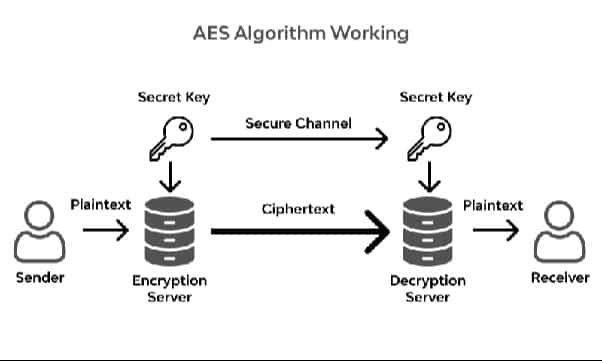
Two algorithm families cover almost every production encryption decision: symmetric algorithms, which use one shared key for both encryption and decryption, and asymmetric algorithms, which use a mathematically linked public and private key pair. AES handles the symmetric side. RSA and ECC handle the asymmetric side.
AES (Advanced Encryption Standard)
AES is a symmetric block cipher standardized by NIST in FIPS 197. It encrypts fixed-size blocks of data using a shared secret key of 128, 192, or 256 bits. AES-256 is the recommended key size for new deployments protecting sensitive organizational data, since it carries the largest security margin against brute-force attacks and is the accepted baseline for compliance frameworks like HIPAA, PCI DSS, and GDPR-aligned data protection controls. AES-128 remains approved and is faster on constrained hardware, but AES-256 is the default choice when data has a long confidentiality lifetime.
RSA (Rivest-Shamir-Adleman)
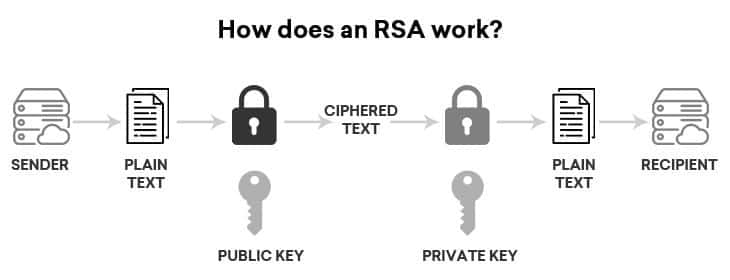
RSA is an asymmetric algorithm built on the difficulty of factoring large numbers. It uses a public key to encrypt data or verify a signature, and a private key to decrypt data or create a signature. RSA is widely deployed for TLS key exchange, code signing, and certificate issuance. For new deployments, use RSA-3072 or larger. RSA-2048 is still permitted under current NIST guidance, but it sits closer to the deprecation boundary and offers less headroom against advancing factorization techniques than RSA-3072. See RSA Padding Explained for how padding scheme choice (PKCS#1 v1.5, OAEP, or PSS) affects real-world RSA security.
ECC (Elliptic Curve Cryptography)
ECC is an asymmetric approach built on the algebraic structure of elliptic curves. It delivers equivalent security to RSA at a much smaller key size: a 256-bit ECC key (curve P-256) offers roughly the same security margin as a 3072-bit RSA key, and a 384-bit ECC key (curve P-384) offers a higher margin still. That smaller key size means faster handshakes and lower bandwidth, which is why ECC (typically ECDSA for signatures and ECDH for key exchange) has become the default asymmetric choice for modern TLS, mobile, and IoT deployments. Use P-256 as a general baseline and P-384 where the data or the workload demands a higher security margin.
Triple DES (3DES): Legacy, Not for New Use
Triple DES applies the original DES cipher three times with either two or three 56-bit keys. It was a reasonable bridge algorithm two decades ago, but NIST withdrew SP 800-67 Revision 2, the publication that approved Triple DES, effective January 1, 2024. Triple DES should not appear in any new design, and any system still using it needs a migration plan to AES-256. See Why 3DES or Triple DES Is Officially Being Retired for the full migration context.
Symmetric vs. Asymmetric: Which One for Which Use Case?
Symmetric encryption (AES) is faster and cheaper computationally, so it handles bulk data: databases, file systems, backups, and the payload of a TLS session once the handshake completes. Asymmetric encryption (RSA or ECC) is slower but solves a problem symmetric encryption cannot: exchanging a secret with someone you have no prior shared key with, and proving identity through digital signatures. In practice, production systems use both together: asymmetric algorithms establish trust and exchange a session key, and a symmetric algorithm does the actual bulk encryption. For a deeper walkthrough of shared-key mechanics, see What Is Symmetric Encryption? The decision table further down in this guide maps each algorithm to its typical production use case and recommended key size.
What Are the Prerequisites for Deploying or Rotating an Encryption Algorithm in Production?
Before you touch a production encryption algorithm or key, confirm the following are in place:
- A cryptographic inventory. Know every system, certificate, and stored dataset that uses the algorithm or key you are changing. You cannot rotate what you have not found.
- Key management infrastructure. An HSM or a managed key management service (KMS) to generate, store, and control access to the new key. Keys should never be generated or stored in application code.
- Access control and approval workflow. Defined roles for who can request, approve, and execute a key rotation or algorithm change, with separation of duties for high-value keys.
- A backup of current keys and encrypted data. Taken and verified restorable before any change begins.
- A maintenance or low-traffic window, if the change requires re-encrypting data in place rather than encrypting new writes only.
- A rollback plan and a logging plan, both defined and reviewed before execution, not improvised after something breaks.
How Do You Implement or Rotate an Encryption Algorithm in Production?
Follow these steps for a new algorithm deployment or a scheduled key rotation:
- Generate the new key inside the HSM or KMS, using the target algorithm and key size (for example, AES-256 or RSA-3072). Never export the raw key material to a general-purpose file system.
- Register the new key with a distinct key ID or version so applications can reference it explicitly and both old and new keys can coexist during the transition.
- Deploy the new key to a limited pilot scope first (one service, one data store, or one certificate) rather than the full estate.
- Encrypt new data with the new key while leaving existing ciphertext under the old key, unless full re-encryption is required by policy.
- Run the validation checks described below against the pilot scope before expanding further.
- Roll out to the remaining scope in stages, validating at each stage rather than deploying to the entire environment at once.
- Re-encrypt or migrate historical data under the new key if policy requires it, tracking progress against the full inventory from the prerequisites step.
- Decommission the old key or algorithm only after every consumer has confirmed migration and the retention period for data encrypted under the old key has passed.
How Do You Validate an Encryption Deployment Before Decommissioning the Old Algorithm?
Validate before you decommission anything, not after. At minimum, confirm:
- Data encrypted with the new key or algorithm decrypts correctly and matches the original plaintext (checksum or hash comparison against a known-good copy).
- All application consumers can reach the new key through the HSM or KMS with the correct permissions, tested under expected production load.
- TLS handshakes, digital signatures, or certificate chains that depend on the new algorithm validate correctly against the relevant clients, browsers, or partner systems.
- Performance (latency, throughput) under the new algorithm meets the same service-level targets as the old one, since asymmetric algorithms with larger key sizes add measurable handshake overhead at scale.
- Backup and disaster recovery processes can restore data encrypted under the new key, tested against an actual restore, not just a documented procedure.
What Is the Rollback Procedure If an Encryption Deployment Fails?
Define the rollback trigger and procedure before deployment starts, not during an incident. A typical rollback:
- Stop new writes under the new key or algorithm and revert application configuration to reference the prior key ID.
- Confirm the old key is still active in the HSM or KMS (this is why the prerequisites step calls for coexistence rather than immediate decommissioning).
- Restore any data re-encrypted during the failed rollout from the pre-change backup, if re-encryption had already begun.
- Verify application functionality against the restored state using the same validation checks used for the forward deployment.
- Log the rollback event, the trigger condition, and the root cause, and hold the new key or algorithm change until the root cause is resolved and re-tested.
A rollback plan only works if the old algorithm or key was kept active through the pilot and staged rollout, which is why decommissioning is the last step in the implementation process above, not an early one.
How Should You Log and Audit Encryption Key Usage and Rotation?
Every key generation, access, rotation, and decommissioning event needs an audit trail that a compliance auditor or incident responder can review independently of the team that performed the action. At minimum, log:
- Who (or which service identity) requested, approved, and executed each key generation or rotation event, with a timestamp.
- Which key ID or version was used for each encryption or decryption operation, so you can trace any dataset back to the exact key that protected it.
- Every failed decryption or access-denied event against a key, which is often the first signal of a misconfiguration or an attempted unauthorized access.
- Key decommissioning events, including confirmation that all dependent consumers had migrated first.
Most HSMs and managed KMS platforms generate this logging natively; the operational gap is usually in routing those logs to a SIEM or audit system your compliance team actually reviews, rather than leaving them in the HSM’s local log store.
What Are Common Implementation Errors, and How Do You Troubleshoot Them?
| Symptom | Likely Cause | Troubleshooting Step |
|---|---|---|
| Decryption fails after a key rotation | Application cached the old key reference or was not updated to the new key ID | Confirm the application’s key reference configuration and force a cache refresh or restart in a controlled window |
| TLS handshake failures after switching to a larger key size | An older client or load balancer does not support the new algorithm or curve | Check client and intermediary compatibility (browsers, API clients, load balancers) before the pilot stage, not after full rollout |
| Unexpected latency increase | Asymmetric operations (especially RSA) at a larger key size add per-connection CPU cost | Confirm TLS session resumption and connection pooling are enabled; consider ECC to reduce per-handshake cost |
| Some data still decrypts under the old key after “rotation is complete” | The cryptographic inventory from the prerequisites step missed a data store or backup archive | Re-run discovery against the full inventory, including backups and archived systems, before decommissioning the old key |
| Key access denied for a legitimate service | Access policy on the new key was not updated to match the old key’s permissions | Diff the IAM or HSM access policy between old and new key before the pilot stage |
What Operational Outcomes Should You Measure?
Track these outcomes to know whether an encryption algorithm deployment or rotation actually succeeded, not just that it completed:
- Zero unplanned downtime attributable to the key rotation or algorithm change, measured against your standard incident tracking.
- 100 percent of the cryptographic inventory migrated to the new key or algorithm within the planned timeline, with no orphaned systems still on the old one.
- Compliance audit pass rate for controls tied to encryption key management (key rotation cadence, access logging, algorithm approval), evidenced by the audit trail from the logging step.
- Mean time to rotate a key or algorithm, tracked over successive rotations, should trend down as the runbook matures.
- Zero decommissioned keys later found still in use, confirmed by the discovery step before each decommissioning.
Which Encryption Algorithm Fits Your Use Case?
| Algorithm | Type | Typical Use Case | Recommended Key Size |
|---|---|---|---|
| AES-256 | Symmetric | Data at rest (databases, disks, backups), TLS bulk encryption | 256-bit key |
| AES-128 | Symmetric | Latency-sensitive or resource-constrained workloads | 128-bit key (256-bit preferred for long-lived data) |
| RSA | Asymmetric | TLS key exchange, code signing, certificate issuance | 3072-bit minimum for new deployments; 2048-bit is the current floor |
| ECC (ECDSA / ECDH) | Asymmetric | Modern TLS, certificate signing, mobile and IoT devices | P-256 baseline, P-384 for a higher security margin |
| ML-KEM (FIPS 203) | Post-quantum, asymmetric key encapsulation | Early pilots for quantum-resistant key exchange alongside classical algorithms | ML-KEM-768 or ML-KEM-1024, implementation-dependent |
| Triple DES (3DES) | Symmetric, legacy | Not for new use; NIST withdrew approval effective January 1, 2024 | N/A, migrate to AES-256 |
Why Encrypt and Decrypt Organizational Data?
-
Protects data confidentiality.
If a system is breached, correctly encrypted data is unreadable to the attacker without the corresponding key, which limits the damage of the breach even after unauthorized access occurs.
-
Supports data integrity verification.
Digital signatures and hash functions let you confirm that data has not been altered in transit or in storage, which encryption alone does not guarantee.
-
Secures network communication.
Encrypted channels (TLS, VPNs) prevent an attacker intercepting network traffic from reading or tampering with the data in transit, blocking man-in-the-middle attacks.
-
Protects PII and PHI.
Encrypting personally identifiable information and protected health information keeps that data unreadable even if unauthorized users gain access, supporting compliance with HIPAA, GDPR, and CCPA.
-
Protects intellectual property.
Encrypting source code, research data, and proprietary content limits exposure if storage or transit systems are compromised.
What Are the Limitations of These Encryption Algorithms?
No algorithm choice is a complete solution on its own. Keep these limitations in view when planning a deployment:
- Asymmetric operations are computationally expensive at scale. RSA and, to a lesser extent, ECC add measurable CPU and latency cost per connection, which is why production systems pair them with symmetric encryption rather than using them for bulk data.
- Key management is harder than algorithm selection. A correctly chosen algorithm protected by a weak key management process (keys in source control, no rotation, broad access) is not meaningfully secure.
- RSA and ECC face a long-term quantum threat. A cryptographically relevant quantum computer would break both through Shor’s algorithm. This is not an immediate operational risk for most organizations, but data with a long confidentiality requirement is already exposed to harvest-now-decrypt-later collection today.
- Post-quantum algorithms are still maturing operationally. FIPS 203, 204, and 205 are finalized standards, but library support, hardware acceleration, and protocol integration (hybrid classical/PQC handshakes) are still rolling out across vendors.
- Implementation errors undermine strong algorithms. Weak padding schemes, poor random number generation, and side-channel leaks have all caused real-world breaks of otherwise sound algorithms; the algorithm is only as strong as its implementation.
What Would Encryption Consulting Recommend?
Start with the cryptographic inventory. You cannot correctly choose, deploy, or rotate an algorithm for data you have not identified. Encryption Consulting’s CBOM Secure discovers and inventories the algorithms, keys, and certificates already running across your environment, so the decision table above becomes a concrete migration plan instead of a general reference.
Once you know what you are protecting, move key generation and storage into a hardware security module rather than leaving key material in application configuration. HSM-as-a-Service gives you FIPS 140-validated key storage without the capital cost or operational burden of running HSM hardware yourself, and it is the infrastructure the implementation steps in this guide assume you already have.
For organizations that need help designing the runbook itself, selecting the right key sizes for a specific compliance obligation, or planning the pilot-to-full-rollout sequence, Encryption Consulting’s Encryption Advisory service works alongside your team to build a deployment plan matched to your environment rather than a generic checklist. Encryption Consulting holds ISO/IEC 27001:2022 and SOC 2 certifications, so the same controls this guide recommends for your environment are the ones we operate under ourselves.
Conclusion
Choosing an encryption algorithm is the easy part: AES-256 for data at rest and in transit, RSA-3072 or ECC P-384 for key exchange and signatures, and a documented migration path off any remaining Triple DES. The harder part, and the part that actually determines whether your organization’s data stays protected, is the operational discipline around deployment: a cryptographic inventory before you start, a staged rollout with validation at each step, a tested rollback plan, an audit trail for every key event, and measurable outcomes you review after each rotation. Treat encryption algorithm deployment as a production change with the same rigor as any other, and it stops being a recurring source of outages, audit findings, and unplanned rollbacks.
Frequently Asked Questions
What is the most secure encryption algorithm for organizational data today? For symmetric encryption, AES-256 is the current standard for sensitive organizational data. For asymmetric encryption, RSA-3072 or ECC P-384 are the recommended choices for new deployments. No single algorithm is universally “most secure” independent of use case; the pairing of AES for bulk data with RSA or ECC for key exchange and signatures is what production systems actually deploy.
Should we move to RSA-3072 if we are currently on RSA-2048? RSA-2048 remains an accepted minimum under current NIST guidance, so there is no emergency requiring an immediate switch. For new systems and for data with a long confidentiality requirement, deploy RSA-3072 or move to ECC P-256/P-384, which gives equivalent or better security at a smaller key size and lower handshake cost.
Do we need to worry about post-quantum cryptography right now? NIST finalized its first three post-quantum standards, FIPS 203 (ML-KEM), FIPS 204 (ML-DSA), and FIPS 205 (SLH-DSA), in August 2024. Most organizations do not need to migrate production systems to PQC algorithms today, but data with a multi-year confidentiality requirement is already exposed to harvest-now-decrypt-later collection, so building a cryptographic inventory and a crypto-agility plan now is worth starting even if the algorithm swap itself comes later.
How often should we rotate encryption keys? Rotation cadence depends on the key’s role, the data it protects, and your compliance obligations; there is no single correct interval for every key. What matters more than the exact cadence is that rotation follows a documented, tested runbook (prerequisites, staged rollout, validation, rollback) every time, rather than an ad hoc process that varies by whoever executes it.
Can we mix encryption algorithms across our environment during a migration? Yes, and in practice you have to. A staged rollout means old and new algorithms coexist for a period while consumers migrate. The key management infrastructure prerequisite in this guide (an HSM or KMS with distinct key IDs) is what makes that coexistence safe to operate and easy to roll back if needed.
References
- NIST, FIPS 197, Advanced Encryption Standard (AES)
- NIST, SP 800-57 Part 1 Revision 5, Recommendation for Key Management
- NIST, SP 800-131A Revision 2, Transitioning the Use of Cryptographic Algorithms and Key Lengths
- NIST, NIST to Withdraw Special Publication 800-67 Revision 2 (Triple DES)
- NIST, NIST Releases First 3 Finalized Post-Quantum Encryption Standards (FIPS 203, 204, 205)
- Key Takeaways
- What Is Cryptography, and How Do Encryption and Decryption Fit In?
- Which Encryption Algorithms Should You Use Today?
- Symmetric vs. Asymmetric: Which One for Which Use Case?
- What Are the Prerequisites for Deploying or Rotating an Encryption Algorithm in Production?
- How Do You Implement or Rotate an Encryption Algorithm in Production?
- How Do You Validate an Encryption Deployment Before Decommissioning the Old Algorithm?
- What Is the Rollback Procedure If an Encryption Deployment Fails?
- How Should You Log and Audit Encryption Key Usage and Rotation?
- What Are Common Implementation Errors, and How Do You Troubleshoot Them?
- What Operational Outcomes Should You Measure?
- Which Encryption Algorithm Fits Your Use Case?
- Why Encrypt and Decrypt Organizational Data?
- What Are the Limitations of These Encryption Algorithms?
- What Would Encryption Consulting Recommend?
- Conclusion
- Frequently Asked Questions