

- Key Takeaways
- What Is a Shift Left Attack?
- The Shift Left Mentality
- Shift Left vs Shift Right Security
- Why Shift Left Attacks Appeal to Attackers
- How Shift Left Attacks Happen
- How to Defend Against Shift Left Attacks
- What Is Shift Left Security, and Why Does It Matter?
- Challenges of Implementing Shift Left Security
- How Encryption Consulting Helps
- Frequently Asked Questions
- Secure Your Development Pipeline
A shift left attack targets the early stages of the software development lifecycle (SDLC), the coding, build, or CI/CD phases, rather than the finished product. Attackers inject a vulnerability or malicious code before software reaches production, so the defect slips past security gates and lands in the released product. SolarWinds is the classic example.
A shift left attack targets the early stages of the software development lifecycle (SDLC), the coding, build, or CI/CD phases, instead of attacking the finished, deployed product. An attacker inserts a vulnerability or malicious code before the software ships, letting the defect pass through security gates and travel down the pipeline into production. The 2020 SolarWinds breach is the best-known example.
Key Takeaways
- A shift left attack strikes early in the SDLC (code, build, CI/CD) rather than at the deployed product, so malicious code rides the pipeline into production.
- It is enabled by rapid development cycles, automated CI/CD trust, and heavy reliance on open-source dependencies.
- ‘Shift left’ security (moving checks earlier) is the defense; the same idea attackers exploit, defenders use to catch issues sooner and cheaper.
- Common methods include compromised code repositories, malicious dependencies, typosquatting and dependency confusion, and poisoned CI/CD pipelines.
- Key defenses: secure development practices, security testing in CI/CD (SAST/DAST), hardened pipelines with cryptographic code signing, supply-chain security (SBOM, signed packages), and strong access control (RBAC, MFA).
What Is a Shift Left Attack?
The term shift left attack refers to an attack on the early stages of the SDLC, the coding, build, or CI/CD phases, rather than a cyber-attack on the end product. The attacker inserts a vulnerability or malware into the application before it goes to production, so the injected defect escapes the security gates as it moves through the pipeline and ultimately resides in the shipped software. Three factors make these attacks possible:
- Rapid development cycles: When speed is prioritized over thorough security checks, deadline pressure leaves flaws in the coding and build stages that attackers can exploit.
- CI/CD pipelines: Continuous integration and deployment automate testing and releases, but weak access controls, misconfigurations, or insufficient pipeline security let an attacker inject code that then traverses the trusted, automated pipeline straight into production.
- Reliance on open-source components: Third-party libraries speed development but can carry hidden vulnerabilities. Compromising a widely used library spreads malicious code across every project that depends on it, as supply-chain attacks like SolarWinds showed.
The SolarWinds breach (2020) is the defining example. Attackers embedded in the build process inserted SUNBURST malware into the Orion software during build time, so it shipped as a legitimate, signed update to thousands of customers, including banks and government agencies. Unlike a traditional attack on live systems, this one struck much earlier in the lifecycle, exploiting the pipeline to achieve widespread impact before deployment.
The Shift Left Mentality
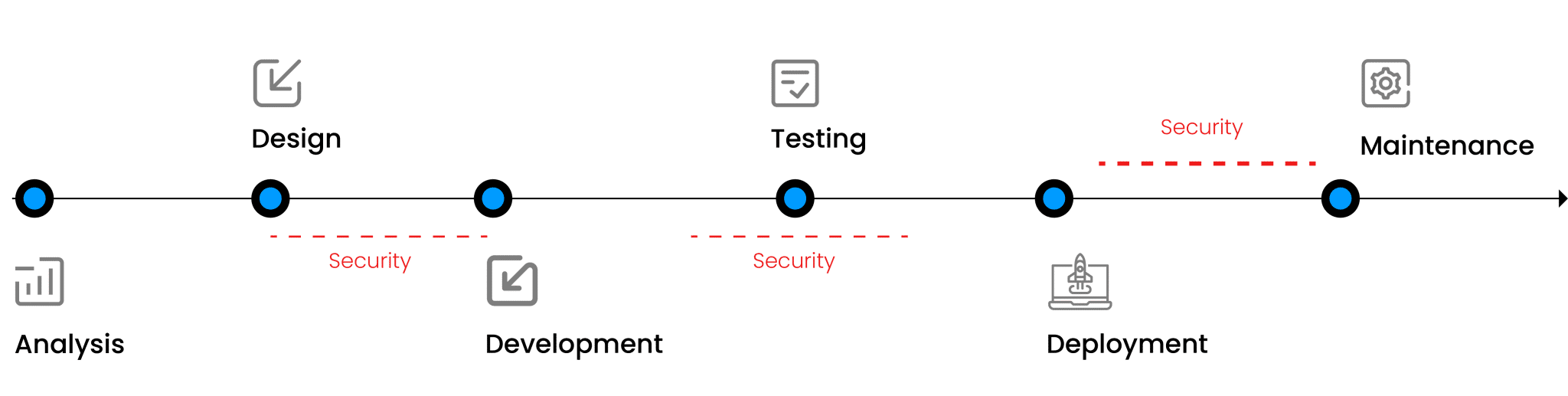
Traditionally, security and quality checks happen at the end of development, so problems surface only at production. The shift left approach moves those checks to the left of the SDLC timeline, catching malware or vulnerabilities before they reach production, using tools like Static Application Security Testing (SAST) and thorough code review. The payoff is cost: fixing a vulnerability in production is widely estimated to cost many times more (often cited as 10 to 30 times) than fixing it during development, because changing a live environment is far more complex and disruptive.
Shift Left vs Shift Right Security
Shift left and shift right are two complementary strategies for securing the SDLC. Shift left builds security in early, catching issues in the design and code phases. Shift right focuses after deployment, on continuous monitoring, incident response, and adapting to real-world attacks. The difference is timing and posture:
| Aspect | Shift Left | Shift Right |
| Timing | Early, during development | After the product is deployed |
| Focus | Prevention and early detection | Monitoring, detection, incident response |
| Approach | Proactive | Reactive |
| Integration | Embedded in development (DevSecOps) | Handled post-deployment via monitoring |
| Cost | More cost-effective, fixed early | More expensive, fixed after release |
| Basis | Theoretical risks and modeling | Actual attack scenarios and real data |
| Examples | Static analysis, threat modeling, early pen testing | Runtime monitoring, post-deployment scanning |
Why Shift Left Attacks Appeal to Attackers
- Lack of detection: Most security tools watch the production environment, so a vulnerability injected earlier in the SDLC simply is not seen. A large share of vulnerabilities are introduced in the design and coding phases yet go undetected until deployment, when they are far more expensive to fix.
- Wide-range impact: Organizations lean heavily on open-source components, and studies of open-source security (such as the annual OSSRA report) have repeatedly found that most codebases contain outdated components, many with no recent development activity and some carrying vulnerabilities years old. One compromised dependency can affect countless downstream deployments.
- Persistent backdoor: Vulnerable dependencies, poor validation of code changes, and missed patches let attackers inject code that keeps running quietly, giving them long-term, hidden access and control.
How Shift Left Attacks Happen
The attack surface spans the whole pipeline, from the developer’s environment through the CI/CD system to production. The main methods:
- Code repository compromise: Attackers gain access to repositories on platforms like GitHub, GitLab, or Bitbucket and inject malware or alter configurations. In one 2024 campaign, attackers created over 100,000 malicious repositories by forking reputable ones and injecting malicious code, a ‘repository confusion’ tactic aimed at developers who clone and run them unknowingly.
- Malicious third-party dependencies: Attackers publish or poison popular packages on managers like npm or PyPI. A 2023 campaign uncovered by Sonatype used compromised npm and PyPI packages, employing typosquatting to steal sensitive developer data such as SSH keys and Kubernetes configurations.
- Compromised developer workstations: Phishing, trojanized IDEs, or backdoored tools let attackers modify code, extract stored credentials, and deliver malware from a trusted machine.
- Typosquatting and dependency confusion: Attackers publish a fake package with a name similar to a real one (for example, lodash as lod4sh) or a high-version public package that overshadows a private one, exploiting automated dependency resolution. In 2021, dependency confusion research showed even Apple and Microsoft internal systems could be reached this way. Tools like Trivy and Kubeaudit help detect such issues.
- Corrupted CI/CD pipelines: Build and deploy systems are prime targets. In the 2021 Codecov incident, a compromised Bash Uploader script (via a Docker image misconfiguration) let attackers exfiltrate secrets from users’ build environments.
- Development-environment misconfigurations: Exposed secrets and insecure local Docker, Kubernetes, or cloud IDE setups leak source code and credentials. In 2017, Uber suffered a breach after AWS credentials were left in a public GitHub repository.
- Malicious pull requests: Attackers hide malware in pull requests to open-source projects, hoping to slip past review. Automated vulnerability scans and requiring multiple approvals on every PR mitigate this.
How to Defend Against Shift Left Attacks
Secure development practices
Integrate security into every SDLC phase: define security requirements early, perform threat modeling, and include security reviews in design and development. Train developers in secure coding (for example, the OWASP guidelines) to avoid issues like hardcoded secrets, SQL injection, and cross-site scripting (XSS).
Shift security left in CI/CD
Add security testing to the pipeline. SAST tools (such as SonarQube) find vulnerabilities in source code early, while DAST tools (such as OWASP ZAP) simulate real attacks against running applications to catch misconfigurations and injections. Together they give a fuller assessment, run continuously in CI/CD.
Harden CI/CD pipelines
Use immutable infrastructure so changes require a new build, store and rotate credentials in a proper secrets manager instead of hardcoding them, and isolate pipelines with strict access controls to prevent lateral movement. Apply cryptographic code signing to all build artifacts so their authenticity and integrity can be verified, and use tools like Snyk or Dependabot to monitor dependencies. Containerized or ephemeral build environments further limit exposure.
Supply chain security
Protect the software supply chain with dependency scanning (such as OWASP Dependency-Check) and by maintaining a Software Bill of Materials (SBOM). Use only signed packages, and keep every dependency patched to the latest secure version.
Access control
Enforce role-based access control (RBAC) across development and production to limit the blast radius of a breach, and require multi-factor authentication (MFA). Microsoft has reported that the vast majority of password-based attacks, around 99 percent, can be blocked by MFA, and MFA is increasingly required under regulations like GDPR and HIPAA.
Where Code Signing Fits
Shift left attacks work by slipping unauthorized code into the build so it ships as though it were legitimate, which is exactly what SolarWinds did. Cryptographic code signing is a direct countermeasure: when every build artifact is signed with a protected key and verified before use, tampered or injected code fails verification and is rejected. Combined with a Software Bill of Materials and signed dependencies, code signing gives you a verifiable chain of trust from source to release. Encryption Consulting’s CodeSign Secure secures the signing keys and automates signing inside the CI/CD pipeline, so integrity checks do not slow developers down.
What Is Shift Left Security, and Why Does It Matter?
Shift left security means addressing security early in the SDLC instead of bolting it on when the application is nearly finished. By moving security responsibilities earlier, teams find and fix vulnerabilities at the cheapest, easiest point, improving both security posture and time-to-market. Its main benefits:
- Early vulnerability detection: Finding issues in design and coding stops them from becoming embedded in the product, avoiding costly rework and breaches later.
- Cost-effective security: Remediation cost rises sharply the closer a flaw gets to production; fixing early avoids downtime, reputation damage, and compliance penalties.
- Better collaboration: Security, development, and operations work together from the start, so security is shared across the lifecycle rather than owned by one team (the DevSecOps model).
- Higher software quality: Writing secure code from the outset produces fewer bugs and more reliable software, treating security and quality as equally important.
Challenges of Implementing Shift Left Security
- Cultural resistance: Shifting left asks developers to own security, which some see as overhead, while security teams may resist giving up centralized control.
- Skill gaps: Many developers lack formal secure-coding training, so organizations must invest in reskilling, which takes time and resources.
- Initial delivery delays: New tools and processes create a learning curve that can slow early releases, though speed recovers as teams adapt.
- Balancing speed and security: Too much security slows delivery; too little leaves vulnerabilities. Striking the balance takes planning, prioritization, and the right tools.
- Tooling and automation: Choosing, configuring, and maintaining security tools is hard, and poorly tuned tools produce false positives and negatives that erode trust in automation.
How Encryption Consulting Helps
Defending the development pipeline depends on strong cryptography, key management, and code integrity. Encryption Consulting’s Encryption Advisory Services assess where secrets and sensitive data live across your development and production environments, identify weaknesses in key handling and pipeline security, and design controls (encryption, access control, and secure secrets management) to close them. For build integrity specifically, CodeSign Secure protects signing keys and automates code signing within CI/CD, so injected or tampered code is caught before release. Backed by ISO/IEC 27001:2022 and SOC 2 certified practices.
Frequently Asked Questions
What is a shift left attack?
A shift left attack targets the early stages of the software development lifecycle, the coding, build, or CI/CD phases, rather than the finished, deployed product. The attacker injects a vulnerability or malicious code before the software ships, so the defect passes through security gates and travels down the pipeline into production. Because most security tools watch production, not development, these attacks often go undetected until the compromised software is already released, as in the SolarWinds breach.
How is a shift left attack different from a traditional attack?
A traditional attack targets live, deployed systems, for example exploiting a vulnerability in running infrastructure. A shift left attack strikes much earlier, inside the development pipeline, by tampering with source code, dependencies, or the build process before deployment. This lets malicious code ship as a legitimate, often signed release to many users at once. The SolarWinds SUNBURST attack is the classic example: malware was inserted at build time and distributed as a trusted software update.
What is the difference between shift left and shift right security?
Shift left security integrates security early in development, focusing on prevention and catching vulnerabilities in the design and coding phases, which is proactive and cost-effective. Shift right security focuses after deployment, on continuous monitoring, incident response, and adapting to real-world attacks, which is reactive but grounded in actual attack data. They are complementary: shift left prevents issues before release, while shift right detects and responds to what happens in production.
How do you prevent shift left attacks?
Prevent shift left attacks by building security into the whole pipeline: adopt secure development practices and threat modeling; run SAST and DAST security testing inside CI/CD; harden pipelines with immutable infrastructure, secure secrets management, and cryptographic code signing of build artifacts; secure the supply chain with dependency scanning, a Software Bill of Materials, and signed packages; and enforce strong access control with RBAC and MFA. Together these catch injected code and tampering before software reaches production.
What role does code signing play in stopping shift left attacks?
Code signing directly counters shift left attacks. These attacks work by inserting unauthorized code into the build so it ships as if legitimate. When every build artifact is cryptographically signed with a protected key and verified before use, tampered or injected code fails that verification and is rejected. Paired with a Software Bill of Materials and signed dependencies, code signing establishes a verifiable chain of trust from source code to released product, which is why it is a core pipeline defense.
Which industries are most affected by shift left attacks?
The most affected industries are technology and software development (heavy use of agile, DevOps, open-source, and CI/CD creates many entry points), healthcare (electronic health records, IoT medical devices, and telehealth expose sensitive patient data), and finance and banking (custom APIs, payment gateways, and third-party integrations create complex, high-value software). Any organization that builds software through modern pipelines and depends on open-source components is exposed and benefits from shifting security left.
Secure Your Development Pipeline
Shift left attacks exploit the gap between fast development and slow security. Closing it means building integrity and cryptographic trust into your pipeline from the first commit. Explore Encryption Consulting’s Encryption Advisory Services and CodeSign Secure to protect your build process against injected and tampered code.
- Key Takeaways
- What Is a Shift Left Attack?
- The Shift Left Mentality
- Shift Left vs Shift Right Security
- Why Shift Left Attacks Appeal to Attackers
- How Shift Left Attacks Happen
- How to Defend Against Shift Left Attacks
- What Is Shift Left Security, and Why Does It Matter?
- Challenges of Implementing Shift Left Security
- How Encryption Consulting Helps
- Frequently Asked Questions
- Secure Your Development Pipeline