

- Key Takeaways
- Which Is Better? The Short Answer
- What Is Symmetric Encryption?
- What Is Asymmetric Encryption?
- Symmetric vs Asymmetric Encryption: Comparison Table
- When to Use Each
- How They Work Together: The Hybrid Model
- A Note on the Post-Quantum Transition
- How Encryption Consulting Helps
- Frequently Asked Questions
- Get the Right Encryption Strategy
Symmetric encryption uses a single shared key to both encrypt and decrypt data, making it fast. Asymmetric encryption uses a public and private key pair, making it slower but able to exchange keys securely and support digital signatures. Neither is strictly better; most systems use both together.
The difference between symmetric and asymmetric encryption comes down to keys. Symmetric encryption uses one shared key for both encryption and decryption, so it is fast and suits bulk data. Asymmetric encryption uses a mathematically linked public and private key pair, which is slower but solves secure key exchange and enables digital signatures. Neither is universally better; real systems combine them in a hybrid model.
Key Takeaways
- Symmetric encryption uses one shared key; asymmetric encryption uses a public and private key pair.
- Symmetric is fast and efficient, ideal for encrypting large amounts of data and data at rest. Asymmetric is slower but solves secure key exchange and enables digital signatures.
- Neither is strictly ‘better’. They solve different problems, and most real systems use both together in a hybrid approach.
- In a hybrid system (like TLS), asymmetric encryption securely exchanges a symmetric session key, then fast symmetric encryption protects the actual data.
- Common symmetric algorithms include AES; common asymmetric algorithms include RSA and ECC. Older ones like DES and RC4 are deprecated.
Which Is Better? The Short Answer
Neither symmetric nor asymmetric encryption is better in general, because they are designed for different jobs. Symmetric encryption wins on speed; asymmetric encryption wins on secure key exchange and identity. Asking which is better is like asking whether a lock or a key courier is better: you need both. In practice, the strongest systems combine them, using asymmetric encryption to safely share a symmetric key, then using fast symmetric encryption for the data itself. The right question is not which to choose, but how to use each for what it does best.
What Is Symmetric Encryption?
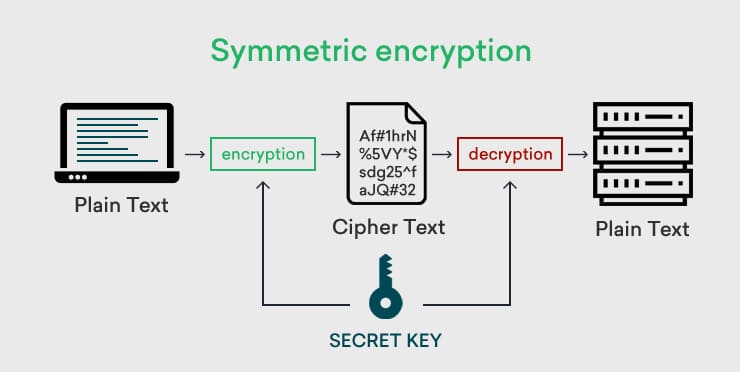
Symmetric encryption uses one key for both encryption and decryption. The same key that turns plaintext into ciphertext turns it back again, so the sender and receiver must both hold the identical key. This makes symmetric encryption simple and very fast, which is why it is the workhorse for encrypting large volumes of data and data at rest, such as records in a database. Its weakness is key distribution: the shared key must be delivered securely, because anyone who obtains it can decrypt the data. See EC’s full explainer on symmetric encryption.
What Is Asymmetric Encryption?
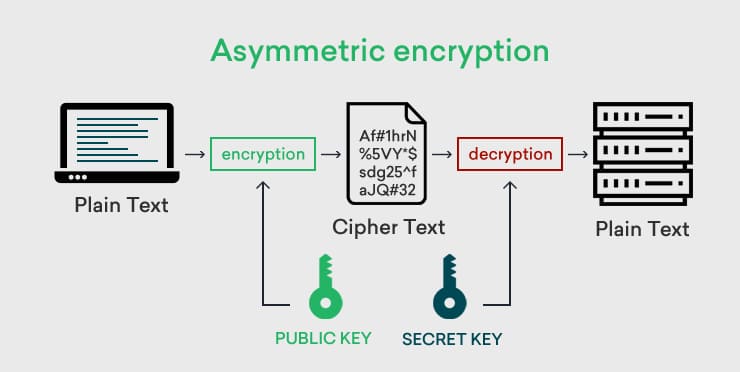
Asymmetric encryption uses a pair of mathematically related keys: a public key that can be shared with anyone, and a private key kept secret by its owner. For confidentiality, data is encrypted with the recipient’s public key and can only be decrypted with their private key, so only the intended recipient can read it, even if it is intercepted. The same key pair also enables digital signatures. Because it removes the need to share a secret key in advance, asymmetric encryption is ideal for open systems and data in transit, but it is significantly slower than symmetric encryption. RSA is the most widely used asymmetric algorithm.
Symmetric vs Asymmetric Encryption: Comparison Table
| Attribute | Symmetric Encryption | Asymmetric Encryption |
| Keys | One shared secret key | Public and private key pair |
| Speed | Fast and efficient | Slower, more computationally intensive |
| Key exchange | Hard: the shared key must be delivered securely | Solved: the public key can be shared openly |
| Best for | Bulk data, data at rest, high-speed encryption | Key exchange, digital signatures, data in transit |
| Digital signatures | Not supported | Supported (private key signs, public key verifies) |
| Main weakness | Distributing and protecting the shared key | Slower performance; larger keys |
| Common algorithms | AES, Twofish (DES, RC4 deprecated) | RSA, ECC, Diffie-Hellman |
| Typical use | Database and disk encryption, TLS session data | TLS handshake, PKI, code signing, secure email |
When to Use Each
Use symmetric encryption for
- Data at rest: Encrypting databases, files, and backups, where speed matters and the same party encrypts and later decrypts.
- Bulk and high-speed data: Large volumes or real-time streams where asymmetric encryption would be too slow.
- Banking and storage systems: Where sensitive data must be encrypted and decrypted quickly and repeatedly.
Use asymmetric encryption for
- Secure key exchange: Safely sharing a symmetric key over an untrusted network, as in the TLS handshake.
- Digital signatures: Proving the identity of a signer and the integrity of data, since only the private key holder can sign.
- Public Key Infrastructure (PKI): Where certificates bind identities to public keys, and code signing, where authenticity must be verifiable by anyone.
How They Work Together: The Hybrid Model
Because each type solves the other’s weakness, most real-world systems combine them. The classic example is TLS, which secures HTTPS websites. When your browser connects to a secure site, asymmetric encryption is used during the handshake to authenticate the server and securely establish a shared secret. From that secret, both sides derive a symmetric session key, and the rest of the session, the actual data, is protected with fast symmetric encryption. This hybrid approach gives the secure key exchange and identity of asymmetric encryption together with the speed of symmetric encryption. It is the reason the ‘which is better’ question misses the point: the best systems use both.
A Note on the Post-Quantum Transition
The two types face very different quantum futures. Asymmetric algorithms like RSA and ECC are vulnerable to a future quantum computer running Shor’s algorithm, which is why they are being replaced by post-quantum standards such as ML-KEM (FIPS 203) and ML-DSA (FIPS 204). Symmetric encryption is far more resilient: the relevant quantum attack (Grover’s algorithm) only halves effective key strength, so AES-256 remains secure. In hybrid systems, it is the asymmetric key exchange that is migrating to post-quantum algorithms, while symmetric encryption continues largely unchanged.
How Encryption Consulting Helps
Choosing the right mix of symmetric and asymmetric encryption for each use case, and managing the keys behind both, is where encryption strategy is won or lost. Encryption Consulting’s Encryption Advisory Services help organizations assess their current encryption, design an architecture that applies each type where it fits, and implement sound key management aligned to NIST and FIPS guidance, including preparation for the post-quantum transition. Backed by ISO/IEC 27001:2022 and SOC 2 certified practices.
Frequently Asked Questions
What is the main difference between symmetric and asymmetric encryption?
The main difference is the number of keys. Symmetric encryption uses a single shared key for both encryption and decryption, while asymmetric encryption uses a pair of keys, a public key and a private key. This difference drives everything else: symmetric encryption is fast but requires securely sharing the one key, while asymmetric encryption is slower but lets the public key be shared openly and supports digital signatures.
Which is better, symmetric or asymmetric encryption?
Neither is better in general, because they solve different problems. Symmetric encryption is faster and better for encrypting large amounts of data, while asymmetric encryption is better for securely exchanging keys, verifying identity, and creating digital signatures. Most real systems use both together: asymmetric encryption to safely share a symmetric key, then fast symmetric encryption for the actual data. The right choice depends on the task, not an overall winner.
Is AES symmetric or asymmetric?
AES (Advanced Encryption Standard) is symmetric. It uses a single shared key for both encryption and decryption and is the most widely used symmetric algorithm, valued for its speed and strong security. AES is commonly used to encrypt data at rest, such as databases and disks, and to protect the data portion of a TLS session after the initial handshake.
Is RSA symmetric or asymmetric?
RSA (Rivest-Shamir-Adleman) is asymmetric. It uses a public and private key pair, where the public key encrypts and the private key decrypts (for confidentiality), or the private key signs and the public key verifies (for digital signatures). RSA is the most widely used asymmetric algorithm and is central to secure key exchange, PKI, and certificates, though it is being migrated to post-quantum algorithms over time.
Why not just use one type of encryption?
Because each type has a weakness the other solves. Symmetric encryption is fast but cannot securely share its key over an untrusted network. Asymmetric encryption can share keys securely but is too slow for bulk data. Using only symmetric encryption leaves the key exchange problem unsolved; using only asymmetric encryption is impractically slow. Combining them in a hybrid model, as TLS does, gives both secure key exchange and high speed.
Which type is affected by quantum computing?
Asymmetric encryption is the type most threatened by quantum computing. Algorithms like RSA and ECC could be broken by a future quantum computer using Shor’s algorithm, which is why they are being replaced by post-quantum standards such as ML-KEM and ML-DSA. Symmetric encryption is far more resistant: the relevant quantum attack only halves effective key strength, so AES-256 remains secure. In hybrid systems, only the asymmetric part needs to migrate.
Get the Right Encryption Strategy
Using symmetric and asymmetric encryption well, each where it fits, with sound key management behind both, is what turns encryption into real protection. Explore Encryption Consulting’s Encryption Advisory Services to design and strengthen your encryption strategy.
- Key Takeaways
- Which Is Better? The Short Answer
- What Is Symmetric Encryption?
- What Is Asymmetric Encryption?
- Symmetric vs Asymmetric Encryption: Comparison Table
- When to Use Each
- How They Work Together: The Hybrid Model
- A Note on the Post-Quantum Transition
- How Encryption Consulting Helps
- Frequently Asked Questions
- Get the Right Encryption Strategy