- Quick Answer: What Are Persistent DCV and DNS Connectors?
- Key Takeaways
- Who Should Care About Persistent DCV and DNS Connectors
- Executive Summary for Security, PKI, Platform, and Compliance Leaders
- The Deadlines Driving the Change
- Why Shorter Certificates Break Manual Domain Validation
- The Data Behind the Urgency
- What Is Domain Control Validation (DCV)?
- What Is Persistent DCV (DNS-PERSIST-01)?
- Traditional DCV vs. Persistent DCV
- What Are DNS Connectors?
- How Persistent DCV and DNS Connectors Work Together
- DCV Automation: Requirements, Failure Modes, and Monitoring Signals
- Prerequisites Before You Implement
- Step-by-Step Implementation Workflow
- Rollback Guidance and Common Errors
- Prerequisite-to-Action Matrix
- Before-and-After: DNS Validation Operations
- Decision Table: Which DNS-01 Automation Path Fits Your Organization
- Owner and Action Matrix by Team
- Success Metrics to Track After Implementation
- What to Do Next
- CertSecure Manager v3.3: CA-Agnostic DNS-01 Automation
- How Encryption Consulting Can Help
- Related Reading From Encryption Consulting
- Conclusion
- Frequently Asked Questions
A certificate that used to renew once a year now has to be re-validated roughly every five to six weeks, and by March 2029 that cadence tightens to every 47 days. Persistent DCV (DNS-PERSIST-01) and DNS connectors are the two controls that make domain control validation keep up: persistent DCV lets a domain be re-verified against a single DNS TXT record published once, and DNS connectors automate the DNS changes that still remain, so certificate teams can meet the CA/Browser Forum’s shrinking validity schedule without manual DNS work at every renewal.
This guide covers what each capability does, the exact deadlines forcing the change, the prerequisites and step-by-step workflow to implement both, the teams responsible for acting on it, and the metrics that show whether the automation is actually working.
Quick Answer: What Are Persistent DCV and DNS Connectors?
Persistent DCV (DNS-PERSIST-01) lets a domain owner publish one TXT record at _validation-persist.[domain] that a CA re-checks automatically at every renewal, eliminating per-renewal DNS work. DNS connectors automate the DNS changes that remain through the provider API. Together they are required to sustain the CA/Browser Forum’s 47-day TLS validity schedule (March 2029, Ballot SC-081v3) without proportional manual effort.
Key Takeaways
- The CA/Browser Forum’s Ballot SC-081v3 cuts maximum public TLS certificate validity to 200 days on March 15, 2026, 100 days on March 15, 2027, and 47 days on March 15, 2029, with DCV reuse periods shrinking on the same schedule down to 10 days.
- Persistent DCV (DNS-PERSIST-01), allowed since November 2025 under Ballot SC-088v3, lets a domain be re-validated against one TXT record published once, removing per-renewal DNS work entirely for established domains.
- DNS connectors automate the DNS changes that remain, including new domains and initial setup, by talking to the DNS provider’s API directly instead of routing through a manual ticket.
- DigiCert’s Trust Pulse Survey (July 2, 2025) found 45% of enterprises had certificate-related downtime in the past year, and 37.5% traced an outage specifically to an expired certificate.
- PKI, security, platform, and compliance teams each own a distinct piece of this rollout; the owner/action matrix and prerequisite checklist below break out exactly who does what.
Jump to: Executive Summary | Implementation Workflow | Prerequisite-to-Action Matrix | Owner/Action Matrix | Success Metrics | CertSecure Manager v3.3 | FAQ
Who Should Care About Persistent DCV and DNS Connectors
The operational consequences of the CA/Browser Forum’s validity reduction schedule land on certificate teams, DNS teams, security architects, platform engineers, and compliance functions simultaneously. Each owns a distinct failure point. A certificate team that automates renewal but does not automate DNS validation still hits the wall when the DCV reuse window expires. A DNS team that grants API access but does not monitor connector credential rotation creates a silent failure mode. At 47-day validity from March 2029, each gap produces renewal failures at eight times the pre-2029 frequency.
| Role | Why It Matters | Action Item |
|---|---|---|
| PKI and Certificate Teams | Own the certificate inventory and CA relationships; must identify which domains qualify for persistent DCV and sequence rollout by risk (SAN and wildcard domains first, since they carry the highest coordination overhead); DigiCert’s Trust Pulse Survey (July 2, 2025) found 45% of enterprises had certificate-related downtime in the past year, and at 47-day validity each manual validation failure produces an outage eight times more frequently than before; only 34% of organizations have a complete and current view of their certificates (DigiCert PKI Under Pressure report, June 2, 2026), making discovery the prerequisite that unblocks everything else | Run a full certificate discovery pass using CertSecure Manager to build an owner-tagged inventory of every publicly trusted certificate and its SAN list; use CBOM Secure to extend discovery beyond TLS certificates to the full cryptographic estate; prioritize SAN and wildcard domains for persistent DCV onboarding first; confirm which issuing CAs already support DNS-PERSIST-01 and use conventional DNS-01 with connectors for those that do not yet |
| Platform and Infrastructure Teams | Own DNS provider access and API credential management, which is the gating prerequisite for connector onboarding; the slowest part of DNS-based validation is usually not the DNS lookup but the human handoff between certificate and DNS teams; a renewal that fails because a DNS change ticket was not processed in time produces exactly the outages DigiCert’s July 2025 survey measured; connector API credentials must be scoped correctly, rotated on schedule, and tested proactively rather than discovered to be expired only when a renewal fails | Request scoped API credentials with TXT-record write access for every DNS provider in use (Route 53, Cloudflare, Azure DNS, Google Cloud DNS, and any others); connect each provider to CertSecure Manager using the DNS connector integration; test that a write-validate-delete TXT record cycle completes programmatically without a ticket before any production certificate depends on it; calendar quarterly credential rotation and test each connector after rotation to confirm it still writes records successfully |
| Security Architects | Own the credential and monitoring governance model that makes persistent DCV secure rather than creating a new standing attack surface; persistent DCV shifts the asset to protect from DNS write access (which must be available at every renewal) to the ACME account key (which is required only to set up the persistent record); a compromised or unmonitored ACME account key that backs a persistent record can authorize certificate issuance for an established domain without triggering a DNS change alert; the _validation-persist record itself must be monitored for unauthorized modification | Add ACME account keys backing persistent DCV records to the organization’s existing secrets management and rotation program before onboarding persistent DCV at scale; configure monitoring alerts on the _validation-persist TXT record for each domain so any unexpected change triggers investigation; define the unauthorized persistent record response playbook (deactivate the ACME account per RFC 8555 Section 7.5.2 to revoke issuance authorization immediately); plan PQC readiness for ACME key algorithms through the PQC Center of Excellence and PQC Readiness services |
| Compliance Teams | Must confirm that automated DCV and DNS connector activity is logged and auditable for regulated frameworks; DORA, NIS2, FedRAMP, and CMMC each require evidence of who validated what domain and when; automated processes that leave no audit trail fail this requirement as surely as manual ones; the CA/Browser Forum SC-081v3 schedule (47-day validity by March 2029) also means that compliance evidence for DCV must be produced at eight times the pre-2029 frequency, making manual audit evidence collection unsustainable by the same logic that makes manual validation unsustainable | Confirm that the certificate lifecycle platform logs every DCV event (domain, method, timestamp, CA account, outcome) with sufficient detail for audit evidence; map DCV and connector activity logs to applicable framework control requirements (DORA Article 9, NIS2 Article 21, FedRAMP SC-12, CMMC Practice CM.L2-3.4.2); require that the log retention period meets framework requirements before moving DCV to full automation; evaluate PKI as a Service for organizations where managed PKI operations include built-in audit logging for DCV activity |
| CISOs | Certificate outages caused by missed validations are operationally equivalent to expired certificate outages but harder to diagnose because the certificate appears valid and trusted but cannot be renewed; DigiCert’s Trust Pulse Survey (July 2, 2025) found 37.5% of certificate-related outages were traced to an expired certificate, and over half caused 5 to 24 hours of downtime with financial losses between $50,000 and $250,000 in 31% of affected organizations; the CA/Browser Forum validity reduction schedule is fixed regardless of organizational readiness, making pre-2026 automation investment a risk-reduction decision rather than an optional upgrade | Fund persistent DCV and DNS connector rollout as an operational risk reduction investment before the March 2026 and March 2027 thresholds take effect; require that certificate automation coverage (percentage of public TLS estate under scheduled CA-agnostic DCV) is reported as a board-level KPI quarterly; mandate that ACME account key protection is included in the secrets management program review; evaluate PKI as a Service for organizations that need a managed certificate lifecycle operation with built-in DCV automation and DNS connector coverage |
Executive Summary for Security, PKI, Platform, and Compliance Leaders
If you lead one of these functions, here is the decision this article supports and the quick-reference checklist to act on it.
- PKI/certificate teams: inventory the public TLS estate, identify which domains qualify for persistent DCV, and prioritize SAN and wildcard domains for onboarding first.
- Security teams: treat the ACME account key behind a persistent record as a sensitive credential, and add certificate-outage risk to the same monitoring tier as other availability risks.
- Platform/infrastructure teams: connect DNS providers to the certificate lifecycle platform via API-based connectors so DNS changes no longer wait on a change-management ticket.
- Compliance teams: confirm that automated DCV and DNS connector activity is logged and auditable, since regulated environments (DORA, NIS2, FedRAMP, CMMC) need evidence of who validated what and when.
The Deadlines Driving the Change
In April 2025 the CA/Browser Forum approved Ballot SC-081v3, “Introduce Schedule of Reducing Validity and Data Reuse Periods,” with 29 votes in favor and none opposed. The ballot, originally proposed by Apple, sets a phased reduction in both the maximum lifetime of publicly trusted TLS certificates and the period during which validation data may be reused. Every publicly trusted TLS certificate is affected, across DV, OV, and EV, including wildcard and multi-domain (SAN) certificates. Sectigo’s own April 14, 2025 analysis of the ballot frames the same schedule as an incremental step, not an abrupt change, toward automated, quantum-ready certificate management.
| Effective date | Max TLS validity | DCV reuse period | SII reuse (OV/EV) |
|---|---|---|---|
| Through Mar 14, 2026 | 398 days | 398 days | 825 days |
| Mar 15, 2026 | 200 days | 200 days | 398 days |
| Mar 15, 2027 | 100 days | 100 days | 398 days |
| Mar 15, 2029 | 47 days | 10 days | 398 days |
Validity and DCV reuse limits apply based on the date a certificate is issued, not the date an order is placed.
The Subject Identity Information (SII) reuse window for OV and EV certificates also drops from 825 days to 398 days on March 15, 2026. This change ends the “set it and forget it” model for high-assurance certificates. For the full set of related mandates, including the separate Chrome dual-EKU deadline of June 15, 2026, see our analysis of the CA/Browser Forum mandate. The same shift is also changing when to rely on a public versus a private CA.
Why Shorter Certificates Break Manual Domain Validation
The challenge does not come from the certificate itself. It comes from the frequency of reissuance. Consider an organization with 1,000 publicly trusted certificates. Today, at 398-day validity, that estate generates roughly 1,000 renewal events a year. By 2029, at 47-day validity, the same estate generates more than 8,000 renewal events a year, an eightfold increase in identical work.
Validation is affected even more directly. When the DCV reuse window falls to 10 days while certificates last 47 days, domain ownership has to be re-proved roughly 35 times per year, per domain. Email-based validation and one-off HTTP file placement cannot run at that cadence. The teams most exposed are those managing large estates, SAN certificates that aggregate many domains under one validation, and wildcard domains. The exposure is greatest where DNS ownership is split across networking, infrastructure, and platform teams, and where every change waits on a change-management ticket.
The implication is clear. At machine-paced renewal frequencies, manual certificate management is no longer viable, and certificate automation becomes the baseline. The question is which form of automation removes the most operational risk.
The Data Behind the Urgency
The math above is not theoretical. Recent industry research quantifies exactly what happens when validation and renewal cannot keep pace with a compressed certificate schedule:
- 45% of enterprises experienced service downtime tied to a certificate-related incident in the past year, and 37.5% traced an outage specifically to an expired certificate, per DigiCert’s Trust Pulse Survey, published July 2, 2025. Over half of affected organizations saw 5 to 24 hours of downtime, and 31% reported financial losses between $50,000 and $250,000.
- 72% of organizations experienced at least one certificate-related outage in the past year, according to CyberArk’s 2025 State of Machine Identity Security Report, which surveyed 1,200 security leaders across six countries.
- Only 34% of organizations have a complete and current view of their digital certificates, and nearly 75% are very or extremely concerned about outages caused by expired certificates, per DigiCert’s “PKI Under Pressure: The Tipping Point for Modernization” report, published June 2, 2026, based on a survey of more than 400 senior IT and security leaders.
- Automated, DNS-validated issuance is already the norm: Let’s Encrypt’s automated ACME issuance alone accounts for more than 60% of all TLS certificates in use, and 94%+ of all certificates issued today are Domain-Validated, most issued instantly by automated processes, as of Q1 2026 (SSLreminder, “State of TLS Q1 2026”).
Persistent DCV and DNS connectors are the mechanisms that let domain validation keep up with that shift toward always-automated issuance, rather than becoming the next operational bottleneck once renewal frequency multiplies.
What Is Domain Control Validation (DCV)?
Domain Control Validation is the process a CA uses to confirm that a certificate applicant controls the domain named in the request. The CA/Browser Forum Baseline Requirements define several accepted methods. The three in common use are:
- DNS-based validation requires the applicant to publish a TXT record under the domain, which the CA then checks. This is the only method that handles wildcard domains and scales cleanly through automation.
- HTTP-based validation requires the applicant to place a file at a known path on the web server. It works for single hosts but becomes awkward across distributed or load-balanced fleets.
- Email-based validation requires the applicant to respond to a message sent to a domain contact. This method is human-gated and is being phased out for automated issuance.
For organizations operating at scale, DNS-based validation is the practical choice. It works for wildcards, it can be driven entirely through APIs, and it underpins the automated issuance protocols that the new timeline effectively makes mandatory, most notably ACME and its DNS-01 challenge. Persistent DCV and DNS connectors both build directly on this DNS-based foundation.
What Is Persistent DCV (DNS-PERSIST-01)?
Persistent DCV is a DNS-based validation method that removes the need to create and tear down a DNS record for every issuance. It was added to the Baseline Requirements as section 3.2.2.4.22, titled “DNS TXT Record with Persistent Value” and widely referred to as DNS-PERSIST-01, through Ballot SC-088v3, and became an allowed method in November 2025. It was proposed by Amazon Trust Services and endorsed by Google Chrome, DigiCert, and Sectigo, among others.
The mechanics are straightforward. Instead of provisioning a fresh, temporary record for each validation event, the domain owner publishes a single account-scoped TXT record once, at the label _validation-persist.[domain]. That record identifies the applicant’s CA account. From then on, the CA performs recurring validation checks against the same record automatically, with no further DNS changes required. Importantly, persistent DCV does not weaken domain ownership verification. The CA/Browser Forum requires it to provide security equivalent to existing DNS-based methods. It changes when and how verification happens, moving from event-driven checks to continuous, automated re-validation. CAs remain bound by the same 10-day reuse cap, and persistent DCV means the underlying record never has to be rebuilt to satisfy it.
The Persistent TXT Record Format
The record itself encodes who is authorized to issue. A persistent TXT record takes the form:
_validation-persist.example.com IN TXT (
    "authority.example;"
    " accounturi=https://authority.example/acct/123;"
    " persistUntil=1782424856"
)
The record name identifies the domain; authority names the CA; accounturi identifies the ACME account authorized to issue (per RFC 8657, and stable across key rotations under RFC 8555 Section 7.3.5); and the optional persistUntil sets an expiry. The CA then re-checks this single record on each issuance.
The operational saving scales with the estate. An organization validating 100 domains four times a year performs roughly 400 DNS changes annually under conventional DNS-01, compared with 100 one-time records under persistent DCV.
One trade-off warrants explicit attention. Because a standing record authorizes issuance, the asset to protect shifts from DNS write access to the ACME account key. Treat that key as a sensitive credential, monitor the persistent record for unexpected changes, and note that issuance can be revoked immediately by deactivating the ACME account (RFC 8555 Section 7.5.2).
Traditional DCV vs. Persistent DCV
| Traditional DNS-based DCV | Persistent DCV (DNS-PERSIST-01) |
|---|---|
| A unique, temporary TXT record is created for each issuance event. | A single persistent TXT record is published once at _validation-persist. |
| The record is added, validated, then removed or rotated every cycle. | The CA re-checks the same record on each issuance; no DNS change needed. |
| DNS coordination is repeated at every renewal, which is the failure point that scales with frequency. | DNS coordination happens once at setup; renewals are decoupled from DNS work. |
| Becomes 8x more frequent as validity shrinks to 47 days. | Frequency of issuance no longer drives DNS workload. |
What Are DNS Connectors?
Persistent DCV reduces how often DNS changes are needed; DNS connectors handle the changes that remain. A DNS connector is an integration between a certificate lifecycle platform and a DNS provider that lets the platform create, update, and validate TXT records programmatically, through the provider’s API, rather than asking a DNS administrator to make each change by hand.
This matters because the slowest part of DNS-based validation is usually not the DNS lookup but the human handoff. A certificate team requests a record, a networking team schedules the change, an approval window passes, and only then can validation complete. At annual cadence that delay is tolerable. At a cadence of dozens of validations per domain per year, it becomes the dominant source of both operational drag and outage risk, because a renewal can fail outright if its validation record is not in place in time. Connectors remove the handoff: the platform talks directly to the DNS provider and the record appears, is validated, and is managed without a ticket.
How Persistent DCV and DNS Connectors Work Together
The two capabilities are complementary, not interchangeable. Persistent DCV eliminates DNS touchpoints during the renewal cycle. DNS connectors automate the DNS changes that are still necessary, including publishing the initial persistent record and onboarding new domains. Used together, they give a team two distinct levers:
- Where a persistent record can be used, DNS changes during renewal are removed entirely, so issuance frequency no longer drives DNS workload.
- Where a DNS change is still required (new domains, initial setup, providers without persistent support), a connector executes it automatically, with no manual coordination.
The net effect is a validation workflow that scales cleanly as both certificate volume and renewal frequency rise, which is exactly what the 2027 and 2029 deadlines demand.
DCV Automation: Requirements, Failure Modes, and Monitoring Signals
Use this table to map each DCV automation requirement to its validation method, the failure mode when the requirement is not met, the monitoring signal that surfaces the failure, and the authoritative policy source. CA/Browser Forum SC-081v3 and SC-088v3 are reviewed on a quarterly cadence and may be updated independently.
| Requirement | Validation Method | Failure Mode | Monitoring Signal | Policy Source |
|---|---|---|---|---|
| Persistent TXT record resolves correctly from all authoritative name servers | Query _validation-persist.[domain] from multiple DNS resolvers in different geographic regions; confirm the same record value is returned from all resolvers; test using public DNS resolvers (Google 8.8.8.8, Cloudflare 1.1.1.1); CLM platform DNS validation check | DNS propagation delay or zone transfer gap causes the CA’s validation check to fail from one or more perspectives; MPIC (CA/Browser Forum SC-067) now checks CAA and DCV from multiple network locations, so an inconsistency visible from one region fails validation; renewal fails even though the record appears correct from a single vantage point | CLM platform alert on DCV validation failure for a domain with a persistent record in place; certificate renewal failure correlating with DNS propagation errors in CA logs; DNS monitoring alert on TXT record propagation failure to one or more authoritative name servers | CA/Browser Forum Ballot SC-088v3 (DNS-PERSIST-01, November 2025); Ballot SC-081v3 (DCV reuse periods); Ballot SC-067 (MPIC, September 2025) |
| DNS connector API credentials are valid, scoped, and tested | Test a write-validate-delete TXT record cycle through the connector before any production certificate depends on it; confirm credentials have TXT-record write access scoped to the specific zones involved (not account-wide); verify credential expiry date; calendar quarterly rotation and test after rotation | Connector with read-only, expired, or over-scoped API credentials fails silently at the next scheduled run; DNS change is not made; the CA’s validation check finds no record; renewal fails; the failure may appear as a DCV error rather than a credential error, making diagnosis slower | CLM platform alert on connector call failure; DNS provider audit log showing failed API authentication; certificate renewal failure spike correlated with credential expiry date; connector health check dashboard showing last successful write timestamp | CA/Browser Forum Ballot SC-081v3 (DCV reuse periods requiring automated validation); DNS provider API authentication documentation; internal credential rotation policy |
| Persistent record accounturi matches the active ACME account for each issuing CA | Compare the accounturi value in the _validation-persist TXT record against the ACME account URL returned by the CA’s account endpoint (RFC 8555 Section 7.3); confirm the account is active and not deactivated; test that the CA accepts the persistent record for a test issuance | Persistent record built for the wrong account (wrong CA, migrated account, or rotated account URL) validates for the wrong CA or not at all; certificate renewal fails; the CA returns a DCV failure that does not explicitly name the accounturi mismatch, making diagnosis slow | CLM platform DCV validation failure for a domain with a persistent record; CA error response citing account not authorized or record not recognized; CLM platform alert on persistent record accounturi value change since last audit | CA/Browser Forum Ballot SC-088v3 Section 3.2.2.4.22 (accounturi field requirement); RFC 8657 (ACME account key rollover stability); RFC 8555 Section 7.3.5 (account URL stability across key rotations) |
| Persistent record is monitored for unauthorized modification | Configure DNS monitoring for the _validation-persist.[domain] TXT record that alerts on any value change; confirm the monitoring platform checks from multiple geographic locations; test the alert by temporarily modifying the record value in a non-production zone | An unauthorized modification to the persistent record goes undetected; the modified record may authorize a different CA or ACME account to issue certificates for the domain; because the record is standing rather than per-renewal, the window of exposure is continuous rather than bounded by a renewal cycle | DNS monitoring alert on _validation-persist TXT record value change; CLM platform alert on unexpected CA or account change in the persistent record; external DNS monitoring service alert on record modification | CA/Browser Forum Ballot SC-088v3 (persistent record security requirements); RFC 8555 Section 7.5.2 (ACME account deactivation to revoke issuance authorization); CA/Browser Forum Baseline Requirements Section 4.9 (certificate revocation obligations) |
| DCV automation runs on a schedule aligned to the renewal cadence | Confirm the CLM platform is configured to run domain validation ahead of each renewal at a frequency that stays within the applicable DCV reuse window (200 days through March 2027, 100 days through March 2029, 10 days from March 2029); test that DCV runs automatically without manual trigger; confirm CA-agnostic scheduling so the same automation applies regardless of which public CA issues the certificate | DCV automation is not scheduled or is configured to a reuse window longer than the applicable limit; the CA’s DCV evidence expires before the next renewal; the CA refuses to issue because domain validation data is stale; this failure mode becomes more frequent as the reuse window shrinks | CLM platform alert on DCV evidence expiry approaching renewal date; certificate renewal failure citing expired DCV evidence in CA logs; CLM platform dashboard showing domains with DCV last-run timestamp older than the applicable reuse window | CA/Browser Forum Ballot SC-081v3 (DCV reuse periods: 200 days March 2026, 100 days March 2027, 10 days March 2029); CA/Browser Forum Baseline Requirements Section 3.2.2.4 (DCV method requirements) |
Prerequisites Before You Implement
Confirm these are in place before onboarding persistent DCV or DNS connectors, so the rollout does not stall midway:
- A current certificate inventory. You need a discovery-backed list of every publicly trusted certificate and the domain(s) it covers before you can decide which domains qualify for persistent DCV.
- API access to each DNS provider in use. DNS connectors authenticate to the provider’s API (Route 53, Cloudflare, Azure DNS, Google Cloud DNS, and similar), so you need API credentials with permission to write TXT records, scoped to the zones involved.
- A CA account that supports ACME and, where available, DNS-PERSIST-01. Confirm which of your issuing CAs already support persistent DCV, since it is a newly allowed method that CAs are still rolling out.
- A named owner for DNS change approval. Even automated DNS changes need a defined owner of record for audit purposes, typically the platform or infrastructure team.
- A certificate lifecycle management platform such as CertSecure Manager capable of scheduling recurring DCV and executing DNS connector calls, rather than one-off scripts.
Step-by-Step Implementation Workflow
Once the prerequisites above are met, the rollout follows five steps. Each step names the outcome you should see before moving to the next.
Step 1: Inventory the Certificate Estate
Discover every publicly trusted certificate, with particular attention to those expiring after March 15, 2026. Discovery gaps, certificates nobody remembers, are the single largest source of silent outages. Tag each certificate with its owning domain, SAN list, and business owner. Outcome: a complete, owner-tagged inventory of the public TLS estate.
Step 2: Onboard DNS Providers
Connect each DNS provider that hosts your zones to the certificate lifecycle platform using its API credentials, so DNS-01 challenge records can be created and verified programmatically. This removes the manual handoff between certificate and DNS teams. Outcome: every DNS provider in the estate is connected, and the platform can write a test TXT record without a manual ticket.
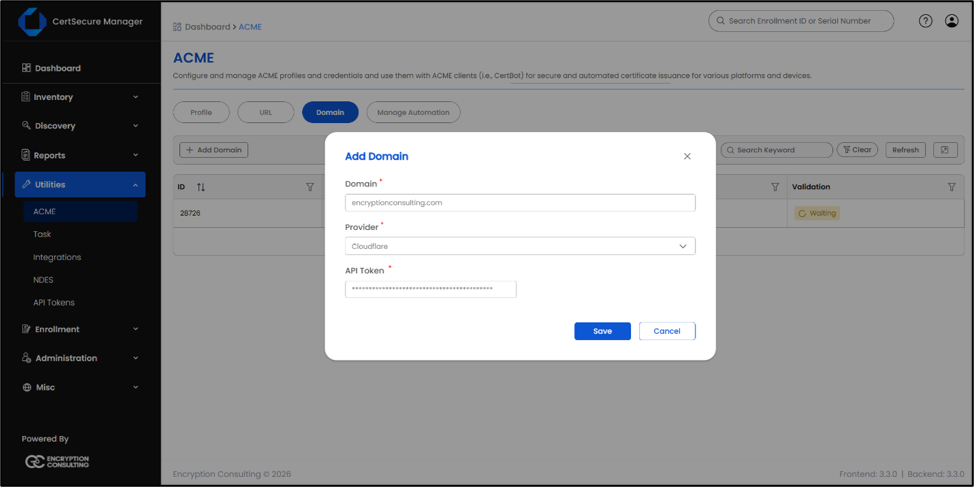
Figure 1. DNS provider onboarding and DNS-01 connector configuration in CertSecure Manager.
Step 3: Publish the Persistent Validation Record
For domains that qualify, publish the one-time TXT record at _validation-persist.[domain] in the format shown earlier, using the connector rather than a manual DNS ticket. Prioritize SAN and wildcard domains first, since they carry the highest coordination overhead under the old model. Outcome: the persistent record resolves correctly and the issuing CA confirms it recognizes the account.
Step 4: Configure Scheduled DCV Automation
Set the certificate lifecycle platform to run recurring domain validation aligned to the renewal cadence your certificates now require, rather than triggering validation manually at each renewal. Keep this CA-agnostic so the same schedule applies no matter which public CA issues a given certificate. Outcome: DCV runs automatically ahead of every renewal, with no per-cycle intervention.
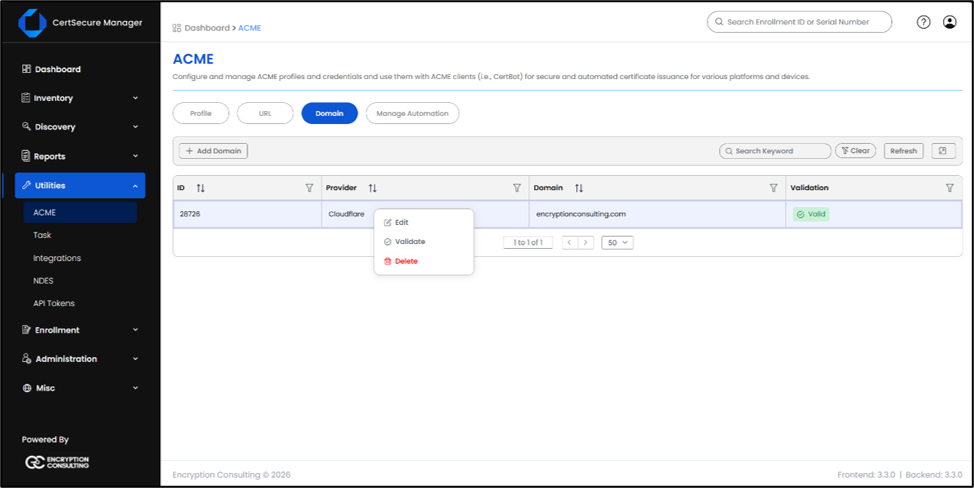
Figure 2. Scheduled DNS-01 domain validation status in CertSecure Manager.
Step 5: Validate, Monitor, and Set Rollback Guardrails
Confirm a full renewal cycle completes end to end without manual intervention, then turn on monitoring for the persistent record (unexpected changes to it are a red flag) and for connector call failures. Document the rollback path before you need it. Outcome: at least one full automated renewal cycle completes successfully, with alerting in place for the record and the connector.
Rollback Guidance and Common Errors
Common Errors to Watch For
- DNS propagation delays. A newly written TXT record that has not propagated across all authoritative name servers will cause the CA’s validation check to fail; build a propagation check into the workflow before triggering issuance.
- API credential scope too narrow or expired. A DNS connector with read-only or expired API credentials will fail silently at the next scheduled run; rotate and test credentials on a calendar, not only when a renewal fails.
- Persistent record published under the wrong CA account. Because the accounturi value ties the record to a specific ACME account, a record built for the wrong account will validate for the wrong CA or not at all.
- No monitoring on the persistent record itself. Since the record authorizes issuance on an ongoing basis, an unnoticed change to it is a higher-impact event than a missed one-off validation used to be.
Rolling Back Safely
If persistent DCV needs to be reversed for a domain, either remove the _validation-persist TXT record or deactivate the associated ACME account (RFC 8555 Section 7.5.2), which revokes issuance authorization immediately. Keep conventional DNS-01 validation available as a fallback path for any domain migrated to persistent DCV, and test that fallback before relying on it in production. For DNS connectors, disable the specific provider integration rather than revoking platform-wide API access, so other providers keep functioning while you troubleshoot.
Prerequisite-to-Action Matrix
| Prerequisite | Action | Owning team |
|---|---|---|
| Certificate inventory incomplete | Run discovery across public and private networks; tag each certificate with domain, SAN list, and owner | PKI/certificate team |
| DNS provider API access not yet granted | Request scoped API credentials with TXT record write permission for each provider | Platform/infrastructure team |
| CA does not yet support DNS-PERSIST-01 | Confirm persistent DCV support directly with each issuing CA; use conventional DNS-01 with connectors in the meantime | PKI/certificate team |
| No named owner for automated DNS changes | Assign and document an owner of record for audit purposes | Security/compliance team |
| No scheduled DCV automation in the lifecycle platform | Configure recurring, CA-agnostic domain validation aligned to renewal cadence | PKI/certificate team |
Before-and-After: DNS Validation Operations
| Operational step | Before (manual) | After (persistent DCV + DNS connectors) |
|---|---|---|
| Requesting a DNS change | Ticket filed with networking team, queued behind other change requests | Certificate platform writes the record directly via the provider’s API |
| Validating domain ownership | Repeated at every renewal, up to ~35 times per year per domain by 2029 | One-time record published for established domains; no per-renewal DNS work |
| Approval turnaround | Hours to days, depending on change-management windows | Minutes, since no human approval sits in the DNS path |
| Failure point under high renewal frequency | Missed or delayed DNS change causes the renewal itself to fail | Renewal proceeds independently of DNS, once the persistent record is in place |
| Audit trail | Scattered across ticketing system, DNS console, and CA portal | Centralized in the certificate lifecycle platform’s connector and DCV logs |
Decision Table: Which DNS-01 Automation Path Fits Your Organization
Not every estate needs the same starting point. Use the table below to match your current environment to the right next step.
| Your situation | Recommended path | Why |
|---|---|---|
| Small estate (fewer than 50 public certificates), annual renewal cadence today | Continue manual or scripted renewal short-term, but plan for 100-day validity by March 2027 | Renewal volume is still low enough to absorb manually, but the 2027 threshold roughly quadruples renewal frequency |
| DNS changes go through a ticket or change-management process | Prioritize DNS connectors first | Removes the human handoff that becomes the failure point once validation must repeat every few weeks |
| Large or SAN/wildcard-heavy estate spanning multiple domains | Adopt persistent DCV (DNS-PERSIST-01) for established domains, paired with DNS connectors for new domains | Removes per-renewal DNS work entirely for domains already validated, cutting DNS changes from hundreds a year to a one-time setup per domain |
| Multi-cloud or hybrid PKI environment spanning multiple public and private CAs | Deploy CA-agnostic automation such as CertSecure Manager v3.3, combining scheduled DCV, DNS connectors, and centralized audit logging | Keeps validation consistent and auditable regardless of which public or private CA issues a given certificate, and avoids rebuilding the workflow when consolidating CAs or cloud providers |
Owner and Action Matrix by Team
| Team | Responsibility | Key action |
|---|---|---|
| PKI/certificate team | Owns the certificate inventory and CA relationships | Identify which domains qualify for persistent DCV and sequence the rollout by risk (SAN/wildcard first) |
| Security team | Owns credential and key protection | Treat ACME account keys behind persistent records as sensitive credentials; monitor for unauthorized changes |
| Platform/infrastructure team | Owns DNS provider access and API credentials | Grant and rotate scoped DNS API credentials; connect each provider to the lifecycle platform |
| Compliance team | Owns audit evidence for regulated frameworks | Confirm DCV and connector activity is logged, retained, and mapped to DORA, NIS2, or FedRAMP/CMMC control requirements |
Success Metrics to Track After Implementation
Track these metrics before and after rollout so the automation’s impact is measurable rather than assumed. Where you have real numbers from your own environment, report them by quarter rather than as a one-time figure.
- Renewal time saved per certificate, comparing manual DNS coordination against connector-driven validation.
- Number of certificates under scheduled, CA-agnostic DCV automation, as a percentage of the total public TLS estate.
- Reduction in manual DNS change tickets filed for certificate validation purposes.
- Certificate-related outages or near-misses, tracked quarterly against the pre-automation baseline.
- Deployment time for onboarding a new DNS provider or domain into the automated workflow.
We have not attached a specific first-party benchmark figure to these metrics here, since we would rather report a verified number from a completed rollout than an estimate. If you are tracking these internally, our PKI Services team can help you baseline and report them.
What to Do Next
- PKI teams: run a discovery pass now and flag every certificate expiring after March 15, 2026 for prioritized migration.
- Security teams: add ACME account keys to your existing secrets-monitoring program before onboarding persistent DCV at scale.
- Platform teams: request DNS provider API access this quarter so connector onboarding is not blocked later by a credentialing delay.
- Compliance teams: confirm your audit framework already accepts automated DCV logs as evidence, or raise the gap now.
CertSecure Manager v3.3: CA-Agnostic DNS-01 Automation
CertSecure Manager is Encryption Consulting’s vendor-neutral certificate lifecycle management platform. Its CA-agnostic design means a single control plane discovers, issues, renews, and governs certificates across every authority an organization uses, so the validity and validation changes ahead are handled centrally rather than authority by authority, and a certificate can be reissued from a different CA if one is disrupted.
This neutrality matters most at the public-trust layer, where the 47-day timeline has the greatest impact. CertSecure Manager integrates natively with the major public trust providers, including DigiCert, GlobalSign, Sectigo, Let’s Encrypt, and Google Public CA, alongside private authorities such as Microsoft AD CS, AWS Private CA, and HashiCorp Vault. Whichever public CA issues a given certificate, discovery, issuance, renewal, and validation are governed from the same console, which is exactly the DNS provider onboarding and scheduled DCV screens walked through in the implementation steps above.
For organizations looking to manage or automate DNS-01 validation specifically, CertSecure Manager v3.3 is built for exactly this transition. Encryption Consulting is actively supporting teams to:
- Onboard their public DNS providers by connecting the providers that host your DNS zones, so that DNS-01 challenge records are created and verified programmatically across a broad range of providers. This removes the manual handoff between certificate and DNS teams.
- Manage DCV through scheduled automation by running recurring domain validation aligned to the renewal cadence that 100-day and 47-day certificates demand, so that DNS-01 evidence stays current without per-cycle intervention.
- Keep validation CA-agnostic by applying the same DNS-01 automation regardless of which public CA issues the certificate, so that consolidating or switching providers does not require rebuilding the validation workflow.
- Build automation-ready workflows across the estate through continuous discovery, policy enforcement, and zero-touch renewal agents, so that renewals at machine pace do not translate into proportional manual effort.
The objective is the operational model the new timeline assumes: domain validation treated as a coordinated, automated system rather than a one-off task repeated at every renewal. Engaging early through inventory, DNS provider onboarding, and scheduled DCV automation gives teams a prioritized roadmap well before the mandatory thresholds take effect.
How Encryption Consulting Can Help
Encryption Consulting is an applied-cryptography and PKI specialist. Beyond providing CertSecure Manager, our PKI Services Practice helps organizations operationalize the move to shorter certificate lifetimes end to end, from first inventory to fully automated, CA-agnostic domain validation. We help teams to:
- Assess 47-day TLS certificate readiness. Discover every publicly trusted certificate, surface the certificate discovery gaps that cause silent outages, and build a prioritized migration roadmap against the 2026 to 2029 milestones.
- Automate DNS-01 validation. Onboard your public DNS providers and stand up scheduled, CA-agnostic domain validation, including persistent DCV (DNS-PERSIST-01) for established domains, so that renewals are decoupled from manual DNS work.
- Deploy and integrate CertSecure Manager. Stand up the platform across your public and private CAs, with renewal agents for zero-touch renewal on web servers, load balancers, and internal applications.
- Design and operate PKI. This covers PKI design and implementation, along with managed options through PKI-as-a-Service and HSM-as-a-Service, including protection of the ACME account keys that persistent DCV makes security-critical.
- Build crypto agility and PQC readiness. This means CA/Browser Forum compliance, RFC-aligned validation, and post-quantum readiness built on our PQC Center of Excellence and 9-phase PQC readiness roadmap, backed by a living CBOM Secure inventory of every cryptographic asset in your estate, so the automation you build now carries through the next transition. Our CBOM: from inventory to intelligence guide walks through turning that inventory into an actionable crypto-agility program.
To assess your certificate estate against the 47-day timeline and build a DNS-01 automation roadmap, talk to Encryption Consulting’s PKI Services team.
Related Reading From Encryption Consulting
Further resources on the deadlines, protocols, and automation discussed above:
- The CA/Browser Forum mandate covers the validity cuts, the June 2026 dual-EKU deadline, and what they require.
- Public CA vs. Private CA explains when to use each and how to build automation for the 47-day timeline.
- Choosing a certificate enrollment protocol compares ACME, EST, SCEP, and CMP for short-lived certificates.
- What is the ACME protocol explains how challenge-response validation, including DNS-01, actually works.
- ACME clients on Linux covers Certbot, acme.sh, DNS provider coverage, and where central governance fits.
- Scaling certificate lifecycle operations with automation shows how to turn frequent renewals into an event-driven, hands-off process.
- CertSecure Manager v3.3 details what the release adds for the higher renewal cadence.
- Centralizing Let’s Encrypt and DNS-01 issuance with CertSecure Manager covers DNS-01 challenge validation across public DNS providers, governed centrally.
- Post-Quantum Cryptography Migration Guide (9 Phases) lays out the roadmap for the algorithm transition that follows the current certificate lifetime and validation changes.
- How to Build a Cryptographic Inventory (CBOM) extends the discovery discipline in this article from TLS certificates to your full cryptographic estate.
- CBOM: From Inventory to Intelligence shows how to turn a cryptographic inventory into an ongoing crypto agility and PQC readiness program.
Conclusion
The trajectory is fixed. By 2029, public TLS certificates will last 47 days and domain validation evidence will expire every 10 days. This turns what was once an annual formality into a continuous operational task. Manual DNS updates and email-based validation cannot keep that pace. Persistent DCV (DNS-PERSIST-01) removes the per-renewal DNS change for established domains, and DNS connectors automate the changes that remain; together they let domain validation scale with issuance frequency instead of breaking under it.
The organizations that navigate this transition smoothly will be the ones that prepare before the thresholds take effect. They inventory their estate, onboard their DNS providers, and move domain validation onto scheduled, CA-agnostic automation now, while 200-day certificates still leave room to adjust. Domain validation is becoming background infrastructure; the task ahead is making it run cleanly before the 2027 deadline forces the issue.
This post is reviewed on a quarterly cadence given the active CA/Browser Forum SC-081v3 and SC-088v3 policy schedules, and immediately whenever the CA/Browser Forum updates DCV reuse periods, adds new persistent DCV requirements, or a major DNS provider changes API authentication behavior.
Frequently Asked Questions
What Is the Main Takeaway From This Guide on Persistent DCV and DNS Connectors?
Public TLS certificate validity is shrinking to 47 days by March 2029, which forces domain ownership to be re-proved roughly 35 times a year per domain. Persistent DCV (DNS-PERSIST-01) removes per-renewal DNS work for established domains by using one standing TXT record, and DNS connectors automate the DNS changes that still remain. Together they are what let domain validation scale with issuance frequency instead of becoming the next bottleneck.
Why Does This Matter for Enterprise Certificate Lifecycle Management?
Certificate lifecycle management already struggles with visibility: DigiCert’s 2026 research found only 34% of organizations have a complete, current view of their certificates. As renewal frequency rises eightfold by 2029, any manual step in validation, especially DNS coordination, multiplies into a proportionally larger source of missed renewals and outages unless it is automated ahead of time.
What Teams Are Responsible for Acting on This Guidance?
Four teams typically share this work: the PKI or certificate team owns the inventory and CA relationships, the platform or infrastructure team owns DNS provider access and connector onboarding, the security team owns protecting the ACME account keys that persistent DCV relies on, and the compliance team owns ensuring automated validation activity is logged for audit purposes. The owner/action matrix above breaks this out in detail.
What Risks Increase If This Topic Is Handled Manually?
DigiCert’s Trust Pulse Survey found 45% of enterprises had certificate-related downtime in the past year, with 37.5% traced directly to an expired certificate; over half of those incidents caused 5 to 24 hours of downtime. Manual DNS coordination is the most common point of failure once validation must repeat every few weeks instead of once a year, because a single missed or delayed DNS change can cause the renewal itself to fail.
How Does Automation Reduce Certificate Outage Risk?
Automation removes the human handoff, ticket queue, and approval window that sit in the DNS path today. Persistent DCV eliminates the DNS step entirely for established domains, and DNS connectors execute any remaining DNS change through the provider’s API in minutes instead of hours or days. Because renewal no longer depends on a human completing a DNS change in time, the most common failure mode behind certificate outages is removed.
What Metrics Should Teams Track After Implementation?
Track renewal time saved per certificate, the percentage of the public TLS estate under scheduled CA-agnostic DCV automation, the reduction in manual DNS change tickets, certificate-related outages or near-misses against a pre-automation baseline, and deployment time for onboarding new DNS providers or domains. Report these quarterly so the trend, not just a single snapshot, shows whether the automation is holding up as renewal frequency increases.
How Does This Connect to 47-Day TLS Certificate Readiness?
The CA/Browser Forum’s Ballot SC-081v3 schedule cuts maximum TLS certificate validity to 200 days on March 15, 2026, 100 days on March 15, 2027, and 47 days on March 15, 2029, with DCV reuse periods shrinking to 10 days on the same timeline. Persistent DCV and DNS connectors are the specific mechanisms that make it operationally possible to hit that cadence without a proportional increase in manual DNS work.
How Should This Be Handled in Multi-Cloud or Hybrid PKI Environments?
Use a CA-agnostic certificate lifecycle platform, such as CertSecure Manager, that applies the same scheduled DCV and DNS connector logic regardless of which public or private CA issues a given certificate, and regardless of which cloud hosts the DNS zone. This avoids rebuilding the validation workflow every time a certificate is reissued from a different CA or a DNS zone moves between providers, which is common in multi-cloud and hybrid PKI estates.
What Prerequisites Are Needed Before Implementation?
You need a current, owner-tagged certificate inventory; API credentials with TXT-record write access for every DNS provider in use; confirmation of which issuing CAs support DNS-PERSIST-01 today; a named owner for automated DNS change approval; and a certificate lifecycle platform capable of scheduling recurring DCV and executing DNS connector calls. The prerequisites section above covers each of these in detail.
What Common Mistakes Should Teams Avoid?
The most frequent mistakes: publishing a persistent record under the wrong ACME account (the accounturi mismatch causes the CA to reject the record silently); not monitoring the _validation-persist record for unauthorized changes (a standing record is a higher-value target than a per-renewal record); failing to propagation-check a newly written TXT record before triggering issuance (DNS propagation delay causes the CA’s MPIC-based multi-perspective check to fail from one region); and not rotating DNS connector API credentials on a calendar (expired credentials fail silently at the next scheduled run, not when they expire).
What Should Be Refreshed Quarterly for DCV Automation Governance?
Quarterly: confirm all persistent records resolve correctly and match authorized ACME accounts; rotate and test DNS connector API credentials; review connector call failure logs for the prior quarter; audit new domains added since the last review for persistent record coverage; verify CA/Browser Forum SC-081v3 and SC-088v3 for updates to DCV reuse periods or persistent record requirements; and confirm PQC readiness planning for ACME key algorithms through the PQC Center of Excellence. This post is reviewed quarterly given the active CA/Browser Forum policy schedule.
- Quick Answer: What Are Persistent DCV and DNS Connectors?
- Key Takeaways
- Who Should Care About Persistent DCV and DNS Connectors
- Executive Summary for Security, PKI, Platform, and Compliance Leaders
- The Deadlines Driving the Change
- Why Shorter Certificates Break Manual Domain Validation
- The Data Behind the Urgency
- What Is Domain Control Validation (DCV)?
- What Is Persistent DCV (DNS-PERSIST-01)?
- Traditional DCV vs. Persistent DCV
- What Are DNS Connectors?
- How Persistent DCV and DNS Connectors Work Together
- DCV Automation: Requirements, Failure Modes, and Monitoring Signals
- Prerequisites Before You Implement
- Step-by-Step Implementation Workflow
- Rollback Guidance and Common Errors
- Prerequisite-to-Action Matrix
- Before-and-After: DNS Validation Operations
- Decision Table: Which DNS-01 Automation Path Fits Your Organization
- Owner and Action Matrix by Team
- Success Metrics to Track After Implementation
- What to Do Next
- CertSecure Manager v3.3: CA-Agnostic DNS-01 Automation
- How Encryption Consulting Can Help
- Related Reading From Encryption Consulting
- Conclusion
- Frequently Asked Questions